Welcome to Subscribe On Youtube
3831. Median of a Binary Search Tree Level 🔒
Description
You are given the root of a Binary Search Tree (BST) and an integer level.
The root node is at level 0. Each level represents the distance from the root.
Return the median value of all node values present at the given level. If the level does not exist or contains no nodes, return -1.
The median is defined as the middle element after sorting the values at that level in non-decreasing order. If the number of values at that level is even, return the upper median (the larger of the two middle elements after sorting).
Example 1:
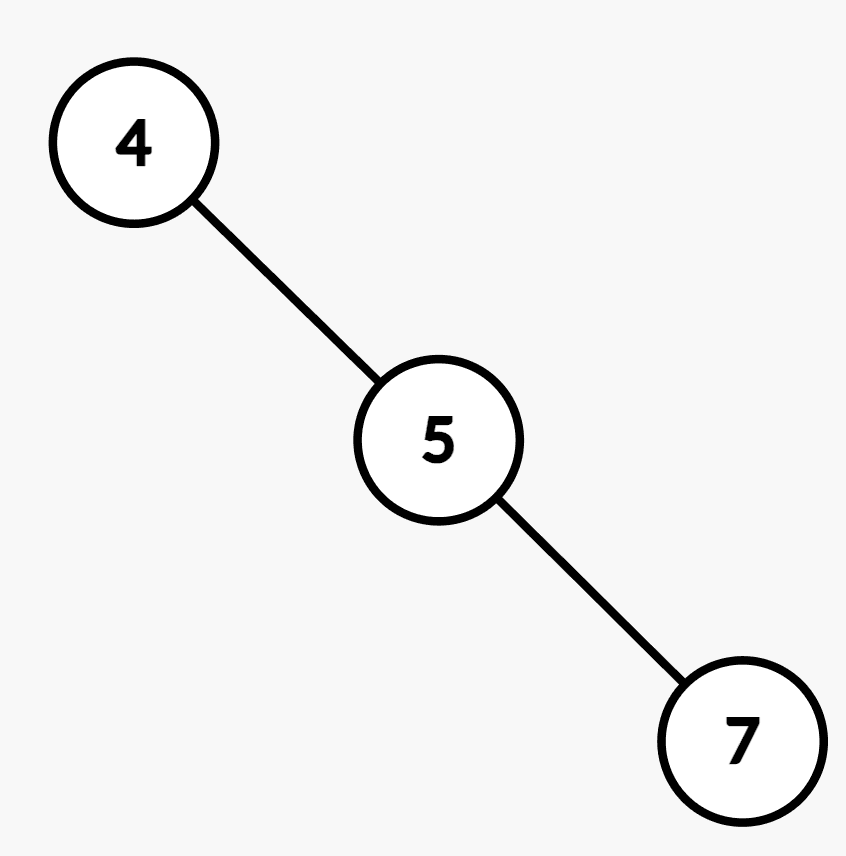
Input: root = [4,null,5,null,7], level = 2
Output: 7
Explanation:
The nodes at level = 2 are [7]. The median value is 7.
Example 2:
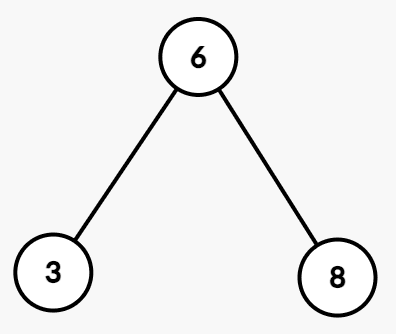
Input: root = [6,3,8], level = 1
Output: 8
Explanation:
The nodes at level = 1 are [3, 8]. There are two possible median values, so the larger one 8 is the answer.
Example 3:
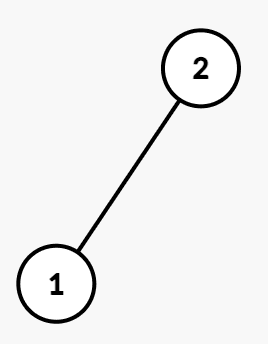
Input: root = [2,1], level = 2
Output: -1
Explanation:
There is no node present at level = 2, so the answer is -1.
Constraints:
- The number of nodes in the tree is in the range
[1, 2 * 105]. 1 <= Node.val <= 1060 <= level <= 2 * 105
Solutions
Solution 1: DFS
We notice that the problem requires us to find the median of node values at a certain level in a binary search tree. Since the definition of median is to sort the node values and take the middle value, and the in-order traversal of a binary search tree is inherently sorted, we can collect the node values at the specified level through in-order traversal.
We define a helper function $\text{dfs}(root, i)$, where $root$ is the current node and $i$ is the level of the current node. In the function, if the current node is empty, we return directly. Otherwise, we recursively traverse the left subtree, check if the level of the current node equals the target level, and if so, add the value of the current node to the result list, and finally recursively traverse the right subtree.
We initialize an empty list $\text{nums}$ to store the node values at the specified level, and call $\text{dfs}(root, 0)$ to start the traversal. Finally, we check if $\text{nums}$ is empty, and if so, return -1, otherwise return the value at the middle position of $\text{nums}$.
The time complexity is $O(n)$ and the space complexity is $O(n)$, where $n$ is the number of nodes in the tree.
Solution 2: Explicit-Stack Inorder
Thinking
The median of one BST level takes the upper middle value when the count is even. Collecting that level and sorting it is correct, and $n$ can be $2 \times 10^5$.
Inorder visits the left child first. A chain of that length recurses once per node and overflows the call stack.
Inorder of a BST is already nondecreasing, so the values of the chosen level appear in sorted order and do not need another sort. A node only needs its own depth.
An explicit stack performs the inorder walk. On entry it pushes an exit marker and the left child; on exit, a node whose depth equals $\textit{level}$ is appended, and then the right child is pushed. The median is $\textit{nums}[\lfloor \textit{nums} /2 \rfloor]$, or $-1$ when the level is empty.
| The median is a sorted middle value, and an inorder walk of a binary search tree is already sorted, so the values on the requested level can be collected in that order. When the count is even, index $\lfloor | \textit{nums} | /2 \rfloor$ is the larger of the two middle values. |
An explicit stack carries the current node, its depth, and whether its left subtree has been expanded. On entry we push an exit marker and the left child. On exit, if the depth equals $\textit{level}$, the node value is appended to $\textit{nums}$, and then the right child is pushed.
An empty $\textit{nums}$ returns $-1$; otherwise the middle entry is the answer.
The time complexity is $O(n)$ and the space complexity is $O(n)$, where $n$ is the number of nodes in the tree.
-
/** * Definition for a binary tree node. * public class TreeNode { * int val; * TreeNode left; * TreeNode right; * TreeNode() {} * TreeNode(int val) { this.val = val; } * TreeNode(int val, TreeNode left, TreeNode right) { * this.val = val; * this.left = left; * this.right = right; * } * } */ class Solution { private List<Integer> nums = new ArrayList<>(); private int level; public int levelMedian(TreeNode root, int level) { this.level = level; dfs(root, 0); return nums.isEmpty() ? -1 : nums.get(nums.size() / 2); } private void dfs(TreeNode root, int i) { if (root == null) { return; } dfs(root.left, i + 1); if (i == level) { nums.add(root.val); } dfs(root.right, i + 1); } } // Solution 2 /** * Definition for a binary tree node. * public class TreeNode { * int val; * TreeNode left; * TreeNode right; * TreeNode() {} * TreeNode(int val) { this.val = val; } * TreeNode(int val, TreeNode left, TreeNode right) { * this.val = val; * this.left = left; * this.right = right; * } * } */ class Solution { private static class Frame { TreeNode node; int i; int state; Frame(TreeNode node, int i, int state) { this.node = node; this.i = i; this.state = state; } } public int levelMedian(TreeNode root, int level) { List<Integer> nums = new ArrayList<>(); if (root == null) { return -1; } Deque<Frame> stk = new ArrayDeque<>(); stk.push(new Frame(root, 0, 0)); while (!stk.isEmpty()) { Frame cur = stk.pop(); TreeNode node = cur.node; if (cur.state == 0) { stk.push(new Frame(node, cur.i, 1)); if (node.left != null) { stk.push(new Frame(node.left, cur.i + 1, 0)); } continue; } if (cur.i == level) { nums.add(node.val); } if (node.right != null) { stk.push(new Frame(node.right, cur.i + 1, 0)); } } return nums.isEmpty() ? -1 : nums.get(nums.size() / 2); } } -
/** * Definition for a binary tree node. * struct TreeNode { * int val; * TreeNode *left; * TreeNode *right; * TreeNode() : val(0), left(nullptr), right(nullptr) {} * TreeNode(int x) : val(x), left(nullptr), right(nullptr) {} * TreeNode(int x, TreeNode *left, TreeNode *right) : val(x), left(left), right(right) {} * }; */ class Solution { public: int levelMedian(TreeNode* root, int level) { vector<int> nums; auto dfs = [&](this auto&& dfs, TreeNode* node, int i) -> void { if (!node) { return; } dfs(node->left, i + 1); if (i == level) { nums.push_back(node->val); } dfs(node->right, i + 1); }; dfs(root, 0); return nums.empty() ? -1 : nums[nums.size() / 2]; } }; // Solution 2 /** * Definition for a binary tree node. * struct TreeNode { * int val; * TreeNode *left; * TreeNode *right; * TreeNode() : val(0), left(nullptr), right(nullptr) {} * TreeNode(int x) : val(x), left(nullptr), right(nullptr) {} * TreeNode(int x, TreeNode *left, TreeNode *right) : val(x), left(left), right(right) {} * }; */ class Solution { public: int levelMedian(TreeNode* root, int level) { vector<int> nums; vector<tuple<TreeNode*, int, int>> stk{{root, 0, 0}}; while (!stk.empty()) { auto [node, i, state] = stk.back(); stk.pop_back(); if (!node) { continue; } if (state == 0) { stk.emplace_back(node, i, 1); stk.emplace_back(node->left, i + 1, 0); continue; } if (i == level) { nums.push_back(node->val); } stk.emplace_back(node->right, i + 1, 0); } return nums.empty() ? -1 : nums[nums.size() / 2]; } }; -
# Definition for a binary tree node. # class TreeNode: # def __init__(self, val=0, left=None, right=None): # self.val = val # self.left = left # self.right = right class Solution: def levelMedian(self, root: Optional[TreeNode], level: int) -> int: def dfs(root: Optional[TreeNode], i: int): if root is None: return dfs(root.left, i + 1) if i == level: nums.append(root.val) dfs(root.right, i + 1) nums = [] dfs(root, 0) return nums[len(nums) // 2] if nums else -1 # Solution 2 # Definition for a binary tree node. # class TreeNode: # def __init__(self, val=0, left=None, right=None): # self.val = val # self.left = left # self.right = right class Solution: def levelMedian(self, root: Optional[TreeNode], level: int) -> int: nums = [] stk = [(root, 0, 0)] while stk: node, i, state = stk.pop() if node is None: continue if state == 0: stk.append((node, i, 1)) stk.append((node.left, i + 1, 0)) continue if i == level: nums.append(node.val) stk.append((node.right, i + 1, 0)) return nums[len(nums) // 2] if nums else -1 -
/** * Definition for a binary tree node. * type TreeNode struct { * Val int * Left *TreeNode * Right *TreeNode * } */ func levelMedian(root *TreeNode, level int) int { nums := make([]int, 0) var dfs func(*TreeNode, int) dfs = func(node *TreeNode, i int) { if node == nil { return } dfs(node.Left, i+1) if i == level { nums = append(nums, node.Val) } dfs(node.Right, i+1) } dfs(root, 0) if len(nums) == 0 { return -1 } return nums[len(nums)/2] } // Solution 2 /** * Definition for a binary tree node. * type TreeNode struct { * Val int * Left *TreeNode * Right *TreeNode * } */ func levelMedian(root *TreeNode, level int) int { nums := make([]int, 0) type frame struct { node *TreeNode i int state int } stk := []frame{{root, 0, 0}} for len(stk) > 0 { cur := stk[len(stk)-1] stk = stk[:len(stk)-1] node, i, state := cur.node, cur.i, cur.state if node == nil { continue } if state == 0 { stk = append(stk, frame{node, i, 1}, frame{node.Left, i + 1, 0}) continue } if i == level { nums = append(nums, node.Val) } stk = append(stk, frame{node.Right, i + 1, 0}) } if len(nums) == 0 { return -1 } return nums[len(nums)/2] } -
/**
 * Definition for a binary tree node.
 * class TreeNode {
 *     val: number
 *     left: TreeNode | null
 *     right: TreeNode | null
 *     constructor(val?: number, left?: TreeNode | null, right?: TreeNode | null) {
 *         this.val = (val===undefined ? 0 : val)
 *         this.left = (left===undefined ? null : left)
 *         this.right = (right===undefined ? null : right)
 *     }
 * }
 */
function levelMedian(root: TreeNode | null, level: number): number {
    const nums: number[] = [];

    const dfs = (node: TreeNode | null, i: number): void => {
        if (node === null) {
            return;
        }
        dfs(node.left, i + 1);
        if (i === level) {
            nums.push(node.val);
        }
        dfs(node.right, i + 1);
    };

    dfs(root, 0);
    if (nums.length === 0) {
        return -1;
    }
    return nums[nums.length >> 1];
}


// Solution 2
/**
 * Definition for a binary tree node.
 * class TreeNode {
 *     val: number
 *     left: TreeNode | null
 *     right: TreeNode | null
 *     constructor(val?: number, left?: TreeNode | null, right?: TreeNode | null) {
 *         this.val = (val===undefined ? 0 : val)
 *         this.left = (left===undefined ? null : left)
 *         this.right = (right===undefined ? null : right)
 *     }
 * }
 */
function levelMedian(root: TreeNode | null, level: number): number {
    const nums: number[] = [];
    const stk: [TreeNode | null, number, number][] = [[root, 0, 0]];
    while (stk.length) {
        const [node, i, state] = stk.pop()!;
        if (node === null) {
            continue;
        }
        if (state === 0) {
            stk.push([node, i, 1]);
            stk.push([node.left, i + 1, 0]);
            continue;
        }
        if (i === level) {
            nums.push(node.val);
        }
        stk.push([node.right, i + 1, 0]);
    }
    if (nums.length === 0) {
        return -1;
    }
    return nums[nums.length >> 1];
}