Welcome to Subscribe On Youtube
2130. Maximum Twin Sum of a Linked List
Description
In a linked list of size n, where n is even, the ith node (0-indexed) of the linked list is known as the twin of the (n-1-i)th node, if 0 <= i <= (n / 2) - 1.
- For example, if
n = 4, then node0is the twin of node3, and node1is the twin of node2. These are the only nodes with twins forn = 4.
The twin sum is defined as the sum of a node and its twin.
Given the head of a linked list with even length, return the maximum twin sum of the linked list.
Example 1:
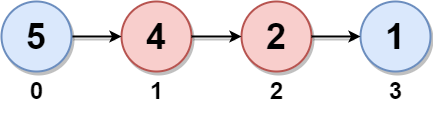
Input: head = [5,4,2,1]
Output: 6
Explanation:
Nodes 0 and 1 are the twins of nodes 3 and 2, respectively. All have twin sum = 6.
There are no other nodes with twins in the linked list.
Thus, the maximum twin sum of the linked list is 6.
Example 2:
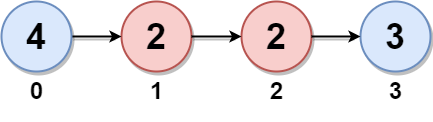
Input: head = [4,2,2,3]
Output: 7
Explanation:
The nodes with twins present in this linked list are:
- Node 0 is the twin of node 3 having a twin sum of 4 + 3 = 7.
- Node 1 is the twin of node 2 having a twin sum of 2 + 2 = 4.
Thus, the maximum twin sum of the linked list is max(7, 4) = 7.
Example 3:
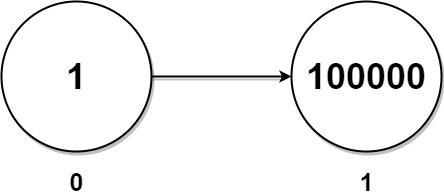
Input: head = [1,100000]
Output: 100001
Explanation:
There is only one node with a twin in the linked list having twin sum of 1 + 100000 = 100001.
Constraints:
- The number of nodes in the list is an even integer in the range
[2, 105]. 1 <= Node.val <= 105
Solutions
Solution 1: Simulation
We can store the values of the nodes in the linked list into an array, then use two pointers pointing to the beginning and end of the array to calculate the twin sum for each pair of twin nodes. The maximum twin sum is the answer.
The time complexity is $O(n)$ and the space complexity is $O(n)$, where $n$ is the number of nodes in the linked list.
Solution 2
Time complexity $O(n)$, space complexity $O(1)$.
-
/** * Definition for singly-linked list. * public class ListNode { * int val; * ListNode next; * ListNode() {} * ListNode(int val) { this.val = val; } * ListNode(int val, ListNode next) { this.val = val; this.next = next; } * } */ class Solution { public int pairSum(ListNode head) { List<Integer> s = new ArrayList<>(); for (; head != null; head = head.next) { s.add(head.val); } int ans = 0, n = s.size(); for (int i = 0; i < (n >> 1); ++i) { ans = Math.max(ans, s.get(i) + s.get(n - 1 - i)); } return ans; } } // Solution 2 /** * Definition for singly-linked list. * public class ListNode { * int val; * ListNode next; * ListNode() {} * ListNode(int val) { this.val = val; } * ListNode(int val, ListNode next) { this.val = val; this.next = next; } * } */ class Solution { public int pairSum(ListNode head) { ListNode slow = head; ListNode fast = head.next; while (fast != null && fast.next != null) { slow = slow.next; fast = fast.next.next; } ListNode pa = head; ListNode q = slow.next; slow.next = null; ListNode pb = reverse(q); int ans = 0; while (pa != null) { ans = Math.max(ans, pa.val + pb.val); pa = pa.next; pb = pb.next; } return ans; } private ListNode reverse(ListNode head) { ListNode dummy = new ListNode(); ListNode curr = head; while (curr != null) { ListNode next = curr.next; curr.next = dummy.next; dummy.next = curr; curr = next; } return dummy.next; } } -
/** * Definition for singly-linked list. * struct ListNode { * int val; * ListNode *next; * ListNode() : val(0), next(nullptr) {} * ListNode(int x) : val(x), next(nullptr) {} * ListNode(int x, ListNode *next) : val(x), next(next) {} * }; */ class Solution { public: int pairSum(ListNode* head) { vector<int> s; for (; head != nullptr; head = head->next) s.push_back(head->val); int ans = 0, n = s.size(); for (int i = 0; i < (n >> 1); ++i) ans = max(ans, s[i] + s[n - i - 1]); return ans; } }; // Solution 2 /** * Definition for singly-linked list. * struct ListNode { * int val; * ListNode *next; * ListNode() : val(0), next(nullptr) {} * ListNode(int x) : val(x), next(nullptr) {} * ListNode(int x, ListNode *next) : val(x), next(next) {} * }; */ class Solution { public: int pairSum(ListNode* head) { ListNode* slow = head; ListNode* fast = head->next; while (fast && fast->next) { slow = slow->next; fast = fast->next->next; } ListNode* pa = head; ListNode* q = slow->next; slow->next = nullptr; ListNode* pb = reverse(q); int ans = 0; while (pa) { ans = max(ans, pa->val + pb->val); pa = pa->next; pb = pb->next; } return ans; } ListNode* reverse(ListNode* head) { ListNode* dummy = new ListNode(); ListNode* curr = head; while (curr) { ListNode* next = curr->next; curr->next = dummy->next; dummy->next = curr; curr = next; } return dummy->next; } }; -
# Definition for singly-linked list. # class ListNode: # def __init__(self, val=0, next=None): # self.val = val # self.next = next class Solution: def pairSum(self, head: Optional[ListNode]) -> int: s = [] while head: s.append(head.val) head = head.next n = len(s) return max(s[i] + s[-(i + 1)] for i in range(n >> 1)) # Solution 2 # Definition for singly-linked list. # class ListNode: # def __init__(self, val=0, next=None): # self.val = val # self.next = next class Solution: def pairSum(self, head: Optional[ListNode]) -> int: def reverse(head): dummy = ListNode() curr = head while curr: next = curr.next curr.next = dummy.next dummy.next = curr curr = next return dummy.next slow, fast = head, head.next while fast and fast.next: slow, fast = slow.next, fast.next.next pa = head q = slow.next slow.next = None pb = reverse(q) ans = 0 while pa and pb: ans = max(ans, pa.val + pb.val) pa = pa.next pb = pb.next return ans -
/** * Definition for singly-linked list. * type ListNode struct { * Val int * Next *ListNode * } */ func pairSum(head *ListNode) int { var s []int for ; head != nil; head = head.Next { s = append(s, head.Val) } ans, n := 0, len(s) for i := 0; i < (n >> 1); i++ { if ans < s[i]+s[n-i-1] { ans = s[i] + s[n-i-1] } } return ans } // Solution 2 /** * Definition for singly-linked list. * type ListNode struct { * Val int * Next *ListNode * } */ func pairSum(head *ListNode) int { reverse := func(head *ListNode) *ListNode { dummy := &ListNode{} curr := head for curr != nil { next := curr.Next curr.Next = dummy.Next dummy.Next = curr curr = next } return dummy.Next } slow, fast := head, head.Next for fast != nil && fast.Next != nil { slow, fast = slow.Next, fast.Next.Next } pa := head q := slow.Next slow.Next = nil pb := reverse(q) ans := 0 for pa != nil { ans = max(ans, pa.Val+pb.Val) pa = pa.Next pb = pb.Next } return ans } -
/** * Definition for singly-linked list. * class ListNode { * val: number * next: ListNode | null * constructor(val?: number, next?: ListNode | null) { * this.val = (val===undefined ? 0 : val) * this.next = (next===undefined ? null : next) * } * } */ function pairSum(head: ListNode | null): number { const arr = []; let node = head; while (node) { arr.push(node.val); node = node.next; } const n = arr.length; let ans = 0; for (let i = 0; i < n >> 1; i++) { ans = Math.max(ans, arr[i] + arr[n - 1 - i]); } return ans; } // Solution 2 /** * Definition for singly-linked list. * class ListNode { * val: number * next: ListNode | null * constructor(val?: number, next?: ListNode | null) { * this.val = (val===undefined ? 0 : val) * this.next = (next===undefined ? null : next) * } * } */ function pairSum(head: ListNode | null): number { let fast = head; let slow = head; while (fast) { fast = fast.next.next; slow = slow.next; } let prev = null; while (slow) { const next = slow.next; slow.next = prev; prev = slow; slow = next; } let left = head; let right = prev; let ans = 0; while (left && right) { ans = Math.max(ans, left.val + right.val); left = left.next; right = right.next; } return ans; } -
// Definition for singly-linked list.
// #[derive(PartialEq, Eq, Clone, Debug)]
// pub struct ListNode {
//   pub val: i32,
//   pub next: Option<Box<ListNode>>
// }
//
// impl ListNode {
//   #[inline]
//   fn new(val: i32) -> Self {
//     ListNode {
//       next: None,
//       val
//     }
//   }
// }
impl Solution {
    pub fn pair_sum(head: Option<Box<ListNode>>) -> i32 {
        let mut arr = Vec::new();
        let mut node = &head;
        while node.is_some() {
            let t = node.as_ref().unwrap();
            arr.push(t.val);
            node = &t.next;
        }
        let n = arr.len();
        let mut ans = 0;
        for i in 0..n >> 1 {
            ans = ans.max(arr[i] + arr[n - 1 - i]);
        }
        ans
    }
}