Welcome to Subscribe On Youtube
2087. Minimum Cost Homecoming of a Robot in a Grid
Description
There is an m x n grid, where (0, 0) is the top-left cell and (m - 1, n - 1) is the bottom-right cell. You are given an integer array startPos where startPos = [startrow, startcol] indicates that initially, a robot is at the cell (startrow, startcol). You are also given an integer array homePos where homePos = [homerow, homecol] indicates that its home is at the cell (homerow, homecol).
The robot needs to go to its home. It can move one cell in four directions: left, right, up, or down, and it can not move outside the boundary. Every move incurs some cost. You are further given two 0-indexed integer arrays: rowCosts of length m and colCosts of length n.
- If the robot moves up or down into a cell whose row is
r, then this move costsrowCosts[r]. - If the robot moves left or right into a cell whose column is
c, then this move costscolCosts[c].
Return the minimum total cost for this robot to return home.
Example 1:
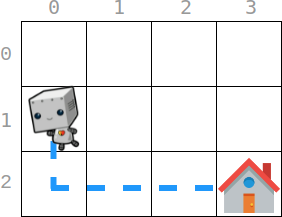
Input: startPos = [1, 0], homePos = [2, 3], rowCosts = [5, 4, 3], colCosts = [8, 2, 6, 7]
Output: 18
Explanation: One optimal path is that:
Starting from (1, 0)
-> It goes down to (2, 0). This move costs rowCosts[2] = 3.
-> It goes right to (2, 1). This move costs colCosts[1] = 2.
-> It goes right to (2, 2). This move costs colCosts[2] = 6.
-> It goes right to (2, 3). This move costs colCosts[3] = 7.
The total cost is 3 + 2 + 6 + 7 = 18
Example 2:
Input: startPos = [0, 0], homePos = [0, 0], rowCosts = [5], colCosts = [26]
Output: 0
Explanation: The robot is already at its home. Since no moves occur, the total cost is 0.
Constraints:
m == rowCosts.lengthn == colCosts.length1 <= m, n <= 1050 <= rowCosts[r], colCosts[c] <= 104startPos.length == 2homePos.length == 20 <= startrow, homerow < m0 <= startcol, homecol < n
Solutions
-
class Solution { public int minCost(int[] startPos, int[] homePos, int[] rowCosts, int[] colCosts) { int i = startPos[0], j = startPos[1]; int x = homePos[0], y = homePos[1]; int ans = 0; if (i < x) { for (int k = i + 1; k <= x; ++k) { ans += rowCosts[k]; } } else { for (int k = x; k < i; ++k) { ans += rowCosts[k]; } } if (j < y) { for (int k = j + 1; k <= y; ++k) { ans += colCosts[k]; } } else { for (int k = y; k < j; ++k) { ans += colCosts[k]; } } return ans; } } -
class Solution { public: int minCost(vector<int>& startPos, vector<int>& homePos, vector<int>& rowCosts, vector<int>& colCosts) { int i = startPos[0], j = startPos[1]; int x = homePos[0], y = homePos[1]; int ans = 0; if (i < x) { ans += accumulate(rowCosts.begin() + i + 1, rowCosts.begin() + x + 1, 0); } else { ans += accumulate(rowCosts.begin() + x, rowCosts.begin() + i, 0); } if (j < y) { ans += accumulate(colCosts.begin() + j + 1, colCosts.begin() + y + 1, 0); } else { ans += accumulate(colCosts.begin() + y, colCosts.begin() + j, 0); } return ans; } }; -
class Solution: def minCost( self, startPos: List[int], homePos: List[int], rowCosts: List[int], colCosts: List[int], ) -> int: i, j = startPos x, y = homePos ans = 0 if i < x: ans += sum(rowCosts[i + 1 : x + 1]) else: ans += sum(rowCosts[x:i]) if j < y: ans += sum(colCosts[j + 1 : y + 1]) else: ans += sum(colCosts[y:j]) return ans -
func minCost(startPos []int, homePos []int, rowCosts []int, colCosts []int) (ans int) { i, j := startPos[0], startPos[1] x, y := homePos[0], homePos[1] if i < x { ans += sum(rowCosts, i+1, x+1) } else { ans += sum(rowCosts, x, i) } if j < y { ans += sum(colCosts, j+1, y+1) } else { ans += sum(colCosts, y, j) } return } func sum(nums []int, i, j int) (s int) { for k := i; k < j; k++ { s += nums[k] } return } -
function minCost( startPos: number[], homePos: number[], rowCosts: number[], colCosts: number[] ): number { const calc = (nums: number[], i: number, j: number): number => { let res = 0; for (let k = i; k <= j; ++k) { res += nums[k]; } return res; }; const [x0, y0] = startPos; const [x1, y1] = homePos; const dx = x0 < x1 ? calc(rowCosts, x0 + 1, x1) : calc(rowCosts, x1, x0 - 1); const dy = y0 < y1 ? calc(colCosts, y0 + 1, y1) : calc(colCosts, y1, y0 - 1); return dx + dy; } -
impl Solution {
    pub fn min_cost(
        start_pos: Vec<i32>,
        home_pos: Vec<i32>,
        row_costs: Vec<i32>,
        col_costs: Vec<i32>,
    ) -> i32 {
        let calc = |nums: &Vec<i32>, i: i32, j: i32| -> i32 {
            let mut res = 0;
            for k in i..=j {
                res += nums[k as usize];
            }
            res
        };

        let x0 = start_pos[0];
        let y0 = start_pos[1];
        let x1 = home_pos[0];
        let y1 = home_pos[1];

        let dx = if x0 < x1 {
            calc(&row_costs, x0 + 1, x1)
        } else {
            calc(&row_costs, x1, x0 - 1)
        };

        let dy = if y0 < y1 {
            calc(&col_costs, y0 + 1, y1)
        } else {
            calc(&col_costs, y1, y0 - 1)
        };

        dx + dy
    }
}