Welcome to Subscribe On Youtube
1340. Jump Game V
Description
Given an array of integers arr and an integer d. In one step you can jump from index i to index:
i + xwhere:i + x < arr.lengthand0 < x <= d.i - xwhere:i - x >= 0and0 < x <= d.
In addition, you can only jump from index i to index j if arr[i] > arr[j] and arr[i] > arr[k] for all indices k between i and j (More formally min(i, j) < k < max(i, j)).
You can choose any index of the array and start jumping. Return the maximum number of indices you can visit.
Notice that you can not jump outside of the array at any time.
Example 1:
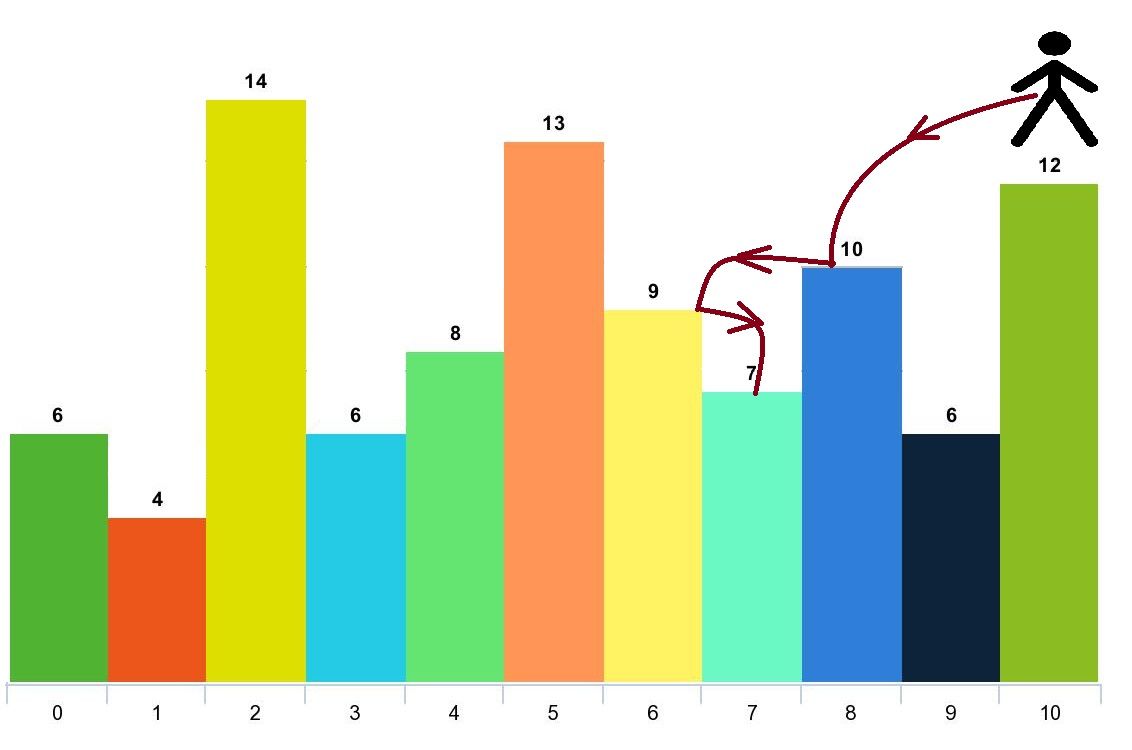
Input: arr = [6,4,14,6,8,13,9,7,10,6,12], d = 2
Output: 4
Explanation: You can start at index 10. You can jump 10 --> 8 --> 6 --> 7 as shown.
Note that if you start at index 6 you can only jump to index 7. You cannot jump to index 5 because 13 > 9. You cannot jump to index 4 because index 5 is between index 4 and 6 and 13 > 9.
Similarly You cannot jump from index 3 to index 2 or index 1.
Example 2:
Input: arr = [3,3,3,3,3], d = 3
Output: 1
Explanation: You can start at any index. You always cannot jump to any index.
Example 3:
Input: arr = [7,6,5,4,3,2,1], d = 1
Output: 7
Explanation: Start at index 0. You can visit all the indicies.
Constraints:
1 <= arr.length <= 10001 <= arr[i] <= 1051 <= d <= arr.length
Solutions
Solution 1: Memoized Search
We design a function $\text{dfs}(i)$ to represent the maximum number of indices that can be visited starting from index $i$. We enumerate all valid jump targets $j$ for $i$, where $i - d \leq j \leq i + d$ and $\text{arr}[i] > \text{arr}[j]$. For each valid $j$, we recursively compute $\text{dfs}(j)$ and take the maximum among them. The final answer is the maximum value of $\text{dfs}(i)$ over all indices $i$.
We can use memoized search to optimize this process, that is, use an array $f$ to record the value of $\text{dfs}$ for each index and avoid repeated computation.
The time complexity is $O(n \times d)$, and the space complexity is $O(n)$, where $n$ is the length of the array $\text{arr}$.
Solution 2: Sorting + Dynamic Programming
We can pair each element $x$ in the array $\text{arr}$ with its index $i$ to form a tuple $(x, i)$, and sort these tuples in ascending order by $x$.
Next, define $f[i]$ to be the maximum number of indices that can be visited starting from index $i$. Initially, $f[i] = 1$, meaning each index can be visited alone as a single jump.
We enumerate $i$ in the order of the tuples $(x, i)$, and enumerate all valid jump targets $j$ for $i$, namely $i - d \leq j \leq i + d$, with $\text{arr}[i] > \text{arr}[j]$. For each valid $j$, we can update $f[i]$, namely $f[i] = \max(f[i], 1 + f[j])$.
The final answer is $\max_{0 \leq i < n} f[i]$.
The time complexity is $O(n \log n + n \times d)$, and the space complexity is $O(n)$. Here, $n$ is the length of the array $\text{arr}$.
Solution 3: Sorting + Dynamic Programming
Thinking
Expanding every jump onto a shorter bar is exponential. The array length can reach $1000$, and the first call from a bar always lands on the next shorter neighbor, so the chain has depth $n$. A jump lands only on a strictly shorter index, and every index in between must also be strictly shorter, so $f[i]$ depends only on shorter indices. Sorting the indices by height makes every legal $j$ already final when $i$ is filled, and the update is $f[i] = \max(f[i], 1 + f[j])$ with each entry starting at $1$. The answer is the largest entry.
We let $f[i]$ be the maximum number of indices that can be visited starting from index $i$, and set $f[i] = 1$ initially.
Sort the indices in increasing order of $\text{arr}[i]$. When index $i$ is processed, scan left and right until the distance exceeds $d$ or a bar at least as tall as $\text{arr}[i]$ appears. For each legal index $j$ on that scan, update $f[i] = \max(f[i], 1 + f[j])$. Shorter bars have already been processed, so $f[j]$ is final.
The answer is the maximum value of $f[i]$.
The time complexity is $O(n \log n + n \times d)$, and the space complexity is $O(n)$, where $n$ is the length of $\text{arr}$.
-
class Solution { private int n; private int d; private int[] arr; private Integer[] f; public int maxJumps(int[] arr, int d) { n = arr.length; this.d = d; this.arr = arr; f = new Integer[n]; int ans = 1; for (int i = 0; i < n; ++i) { ans = Math.max(ans, dfs(i)); } return ans; } private int dfs(int i) { if (f[i] != null) { return f[i]; } int ans = 1; for (int j = i - 1; j >= 0; --j) { if (i - j > d || arr[j] >= arr[i]) { break; } ans = Math.max(ans, 1 + dfs(j)); } for (int j = i + 1; j < n; ++j) { if (j - i > d || arr[j] >= arr[i]) { break; } ans = Math.max(ans, 1 + dfs(j)); } return f[i] = ans; } } // Solution 2 class Solution { public int maxJumps(int[] arr, int d) { int n = arr.length; Integer[] idx = new Integer[n]; Arrays.setAll(idx, i -> i); Arrays.sort(idx, (i, j) -> arr[i] - arr[j]); int[] f = new int[n]; Arrays.fill(f, 1); int ans = 0; for (int i : idx) { for (int j = i - 1; j >= 0; --j) { if (i - j > d || arr[j] >= arr[i]) { break; } f[i] = Math.max(f[i], 1 + f[j]); } for (int j = i + 1; j < n; ++j) { if (j - i > d || arr[j] >= arr[i]) { break; } f[i] = Math.max(f[i], 1 + f[j]); } ans = Math.max(ans, f[i]); } return ans; } } // Solution 3 class Solution { public int maxJumps(int[] arr, int d) { int n = arr.length; Integer[] idx = new Integer[n]; Arrays.setAll(idx, i -> i); Arrays.sort(idx, (i, j) -> arr[i] - arr[j]); int[] f = new int[n]; Arrays.fill(f, 1); int ans = 0; for (int i : idx) { for (int j = i - 1; j >= 0; --j) { if (i - j > d || arr[j] >= arr[i]) { break; } f[i] = Math.max(f[i], 1 + f[j]); } for (int j = i + 1; j < n; ++j) { if (j - i > d || arr[j] >= arr[i]) { break; } f[i] = Math.max(f[i], 1 + f[j]); } ans = Math.max(ans, f[i]); } return ans; } } -
class Solution { public: int maxJumps(vector<int>& arr, int d) { int n = arr.size(); int f[n]; memset(f, 0, sizeof(f)); function<int(int)> dfs = [&](int i) -> int { if (f[i]) { return f[i]; } int ans = 1; for (int j = i - 1; j >= 0; --j) { if (i - j > d || arr[j] >= arr[i]) { break; } ans = max(ans, 1 + dfs(j)); } for (int j = i + 1; j < n; ++j) { if (j - i > d || arr[j] >= arr[i]) { break; } ans = max(ans, 1 + dfs(j)); } return f[i] = ans; }; int ans = 1; for (int i = 0; i < n; ++i) { ans = max(ans, dfs(i)); } return ans; } }; // Solution 2 class Solution { public: int maxJumps(vector<int>& arr, int d) { int n = arr.size(); vector<int> idx(n); iota(idx.begin(), idx.end(), 0); sort(idx.begin(), idx.end(), [&](int i, int j) { return arr[i] < arr[j]; }); vector<int> f(n, 1); for (int i : idx) { for (int j = i - 1; j >= 0; --j) { if (i - j > d || arr[j] >= arr[i]) { break; } f[i] = max(f[i], 1 + f[j]); } for (int j = i + 1; j < n; ++j) { if (j - i > d || arr[j] >= arr[i]) { break; } f[i] = max(f[i], 1 + f[j]); } } return ranges::max(f); } }; // Solution 3 class Solution { public: int maxJumps(vector<int>& arr, int d) { int n = arr.size(); vector<int> idx(n); iota(idx.begin(), idx.end(), 0); sort(idx.begin(), idx.end(), [&](int i, int j) { return arr[i] < arr[j]; }); vector<int> f(n, 1); for (int i : idx) { for (int j = i - 1; j >= 0; --j) { if (i - j > d || arr[j] >= arr[i]) { break; } f[i] = max(f[i], 1 + f[j]); } for (int j = i + 1; j < n; ++j) { if (j - i > d || arr[j] >= arr[i]) { break; } f[i] = max(f[i], 1 + f[j]); } } return ranges::max(f); } }; -
class Solution: def maxJumps(self, arr: List[int], d: int) -> int: @cache def dfs(i): ans = 1 for j in range(i - 1, -1, -1): if i - j > d or arr[j] >= arr[i]: break ans = max(ans, 1 + dfs(j)) for j in range(i + 1, n): if j - i > d or arr[j] >= arr[i]: break ans = max(ans, 1 + dfs(j)) return ans n = len(arr) return max(dfs(i) for i in range(n)) # Solution 2 class Solution: def maxJumps(self, arr: List[int], d: int) -> int: n = len(arr) f = [1] * n for x, i in sorted(zip(arr, range(n))): for j in range(i - 1, -1, -1): if i - j > d or arr[j] >= x: break f[i] = max(f[i], 1 + f[j]) for j in range(i + 1, n): if j - i > d or arr[j] >= x: break f[i] = max(f[i], 1 + f[j]) return max(f) # Solution 3 class Solution: def maxJumps(self, arr: List[int], d: int) -> int: n = len(arr) f = [1] * n for x, i in sorted(zip(arr, range(n))): for j in range(i - 1, -1, -1): if i - j > d or arr[j] >= x: break f[i] = max(f[i], 1 + f[j]) for j in range(i + 1, n): if j - i > d or arr[j] >= x: break f[i] = max(f[i], 1 + f[j]) return max(f) -
func maxJumps(arr []int, d int) (ans int) { n := len(arr) f := make([]int, n) var dfs func(int) int dfs = func(i int) int { if f[i] != 0 { return f[i] } ans := 1 for j := i - 1; j >= 0; j-- { if i-j > d || arr[j] >= arr[i] { break } ans = max(ans, 1+dfs(j)) } for j := i + 1; j < n; j++ { if j-i > d || arr[j] >= arr[i] { break } ans = max(ans, 1+dfs(j)) } f[i] = ans return ans } for i := 0; i < n; i++ { ans = max(ans, dfs(i)) } return } // Solution 2 func maxJumps(arr []int, d int) int { n := len(arr) idx := make([]int, n) f := make([]int, n) for i := range f { idx[i] = i f[i] = 1 } sort.Slice(idx, func(i, j int) bool { return arr[idx[i]] < arr[idx[j]] }) for _, i := range idx { for j := i - 1; j >= 0; j-- { if i-j > d || arr[j] >= arr[i] { break } f[i] = max(f[i], 1+f[j]) } for j := i + 1; j < n; j++ { if j-i > d || arr[j] >= arr[i] { break } f[i] = max(f[i], 1+f[j]) } } return slices.Max(f) } // Solution 3 func maxJumps(arr []int, d int) int { n := len(arr) idx := make([]int, n) f := make([]int, n) for i := range f { idx[i] = i f[i] = 1 } sort.Slice(idx, func(i, j int) bool { return arr[idx[i]] < arr[idx[j]] }) for _, i := range idx { for j := i - 1; j >= 0; j-- { if i-j > d || arr[j] >= arr[i] { break } f[i] = max(f[i], 1+f[j]) } for j := i + 1; j < n; j++ { if j-i > d || arr[j] >= arr[i] { break } f[i] = max(f[i], 1+f[j]) } } return slices.Max(f) } -
function maxJumps(arr: number[], d: number): number { const n = arr.length; const f: number[] = new Array(n).fill(0); const dfs = (i: number): number => { if (f[i] !== 0) { return f[i]; } let ans = 1; for (let j = i - 1; j >= 0; j--) { if (i - j > d || arr[j] >= arr[i]) { break; } ans = Math.max(ans, 1 + dfs(j)); } for (let j = i + 1; j < n; j++) { if (j - i > d || arr[j] >= arr[i]) { break; } ans = Math.max(ans, 1 + dfs(j)); } f[i] = ans; return ans; }; let ans = 0; for (let i = 0; i < n; i++) { ans = Math.max(ans, dfs(i)); } return ans; } // Solution 2 function maxJumps(arr: number[], d: number): number { const n = arr.length; const f: number[] = new Array(n).fill(1); const idx: number[] = Array.from({ length: n }, (_, i) => i); idx.sort((a, b) => arr[a] - arr[b]); for (const i of idx) { for (let j = i - 1; j >= 0; j--) { if (i - j > d || arr[j] >= arr[i]) { break; } f[i] = Math.max(f[i], 1 + f[j]); } for (let j = i + 1; j < n; j++) { if (j - i > d || arr[j] >= arr[i]) { break; } f[i] = Math.max(f[i], 1 + f[j]); } } return Math.max(...f); } // Solution 3 function maxJumps(arr: number[], d: number): number { const n = arr.length; const f: number[] = new Array(n).fill(1); const idx: number[] = Array.from({ length: n }, (_, i) => i); idx.sort((a, b) => arr[a] - arr[b]); for (const i of idx) { for (let j = i - 1; j >= 0; j--) { if (i - j > d || arr[j] >= arr[i]) { break; } f[i] = Math.max(f[i], 1 + f[j]); } for (let j = i + 1; j < n; j++) { if (j - i > d || arr[j] >= arr[i]) { break; } f[i] = Math.max(f[i], 1 + f[j]); } } return Math.max(...f); } -
impl Solution {
    pub fn max_jumps(arr: Vec<i32>, d: i32) -> i32 {
        fn dfs(i: usize, n: usize, d: usize, arr: &[i32], f: &mut Vec<i32>) -> i32 {
            if f[i] != 0 {
                return f[i];
            }
            let mut ans = 1;
            let mut j = (i as isize) - 1;
            while j >= 0 {
                if i - (j as usize) > d || arr[j as usize] >= arr[i] {
                    break;
                }
                ans = ans.max(1 + dfs(j as usize, n, d, arr, f));
                j -= 1;
            }
            j = (i as isize) + 1;
            while (j as usize) < n {
                if j as usize - i > d || arr[j as usize] >= arr[i] {
                    break;
                }
                ans = ans.max(1 + dfs(j as usize, n, d, arr, f));
                j += 1;
            }
            f[i] = ans;
            ans
        }
        let n = arr.len();
        let d = d as usize;
        let mut f = vec![0; n];
        let mut ans = 0;
        for i in 0..n {
            ans = ans.max(dfs(i, n, d, &arr, &mut f));
        }
        ans
    }
}


// Solution 2
impl Solution {
    pub fn max_jumps(arr: Vec<i32>, d: i32) -> i32 {
        let n = arr.len();
        let d = d as usize;

        let mut idx: Vec<usize> = (0..n).collect();
        idx.sort_by_key(|&i| arr[i]);

        let mut f = vec![1; n];

        for &i in &idx {
            let mut j = i as i32 - 1;
            while j >= 0 {
                let k = j as usize;

                if i - k > d || arr[k] >= arr[i] {
                    break;
                }

                f[i] = f[i].max(1 + f[k]);
                j -= 1;
            }

            let mut j = i + 1;
            while j < n {
                if j - i > d || arr[j] >= arr[i] {
                    break;
                }

                f[i] = f[i].max(1 + f[j]);
                j += 1;
            }
        }

        *f.iter().max().unwrap()
    }
}


// Solution 3
impl Solution {
    pub fn max_jumps(arr: Vec<i32>, d: i32) -> i32 {
        let n = arr.len();
        let d = d as usize;

        let mut idx: Vec<usize> = (0..n).collect();
        idx.sort_by_key(|&i| arr[i]);

        let mut f = vec![1; n];

        for &i in &idx {
            let mut j = i as i32 - 1;
            while j >= 0 {
                let k = j as usize;

                if i - k > d || arr[k] >= arr[i] {
                    break;
                }

                f[i] = f[i].max(1 + f[k]);
                j -= 1;
            }

            let mut j = i + 1;
            while j < n {
                if j - i > d || arr[j] >= arr[i] {
                    break;
                }

                f[i] = f[i].max(1 + f[j]);
                j += 1;
            }
        }

        *f.iter().max().unwrap()
    }
}