Welcome to Subscribe On Youtube
1039. Minimum Score Triangulation of Polygon
Description
You have a convex n-sided polygon where each vertex has an integer value. You are given an integer array values where values[i] is the value of the ith vertex (i.e., clockwise order).
You will triangulate the polygon into n - 2 triangles. For each triangle, the value of that triangle is the product of the values of its vertices, and the total score of the triangulation is the sum of these values over all n - 2 triangles in the triangulation.
Return the smallest possible total score that you can achieve with some triangulation of the polygon.
Example 1:
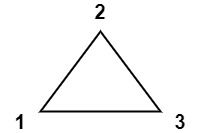
Input: values = [1,2,3]
Output: 6
Explanation: The polygon is already triangulated, and the score of the only triangle is 6.
Example 2:
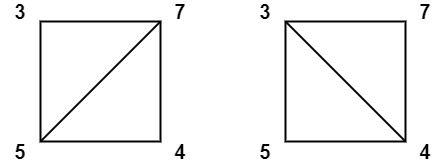
Input: values = [3,7,4,5]
Output: 144
Explanation: There are two triangulations, with possible scores: 3*7*5 + 4*5*7 = 245, or 3*4*5 + 3*4*7 = 144.
The minimum score is 144.
Example 3:
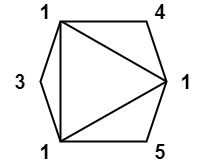
Input: values = [1,3,1,4,1,5]
Output: 13
Explanation: The minimum score triangulation has score 1*1*3 + 1*1*4 + 1*1*5 + 1*1*1 = 13.
Constraints:
n == values.length3 <= n <= 501 <= values[i] <= 100
Solutions
Solution 1: Memoization
We design a function $\text{dfs}(i, j)$, which represents the minimum score after triangulating the polygon from vertex $i$ to $j$. The answer is $\text{dfs}(0, n - 1)$.
The calculation process of $\text{dfs}(i, j)$ is as follows:
- If $i + 1 = j$, it means the polygon has only two vertices and cannot be triangulated, so we return $0$;
- Otherwise, we enumerate a vertex $k$ between $i$ and $j$, i.e., $i \lt k \lt j$. Triangulating the polygon from vertex $i$ to $j$ can be divided into two subproblems: triangulating the polygon from vertex $i$ to $k$ and triangulating the polygon from vertex $k$ to $j$. The minimum scores of these two subproblems are $\text{dfs}(i, k)$ and $\text{dfs}(k, j)$, respectively. The score of the triangle formed by vertices $i$, $j$, and $k$ is $\text{values}[i] \times \text{values}[k] \times \text{values}[j]$. Thus, the minimum score for this triangulation is $\text{dfs}(i, k) + \text{dfs}(k, j) + \text{values}[i] \times \text{values}[k] \times \text{values}[j]$. We take the minimum value of all possibilities, which is the value of $\text{dfs}(i, j)$.
To avoid repeated calculations, we can use memoization, i.e., use a hash table or an array to store the already computed function values.
Finally, we return $\text{dfs}(0, n - 1)$.
The time complexity is $O(n^3)$, and the space complexity is $O(n^2)$, where $n$ is the number of vertices in the polygon.
Solution 2: Dynamic Programming
We can convert the memoization approach in Solution 1 into a dynamic programming approach.
Define $f[i][j]$ as the minimum score after triangulating the polygon from vertex $i$ to $j$. Initially, $f[i][j] = 0$, and the answer is $f[0][n-1]$.
For $f[i][j]$ (where $i + 1 \lt j$), we first initialize $f[i][j]$ to $\infty$.
We enumerate a vertex $k$ between $i$ and $j$, i.e., $i \lt k \lt j$. Triangulating the polygon from vertex $i$ to $j$ can be divided into two subproblems: triangulating the polygon from vertex $i$ to $k$ and triangulating the polygon from vertex $k$ to $j$. The minimum scores of these two subproblems are $f[i][k]$ and $f[k][j]$, respectively. The score of the triangle formed by vertices $i$, $j$, and $k$ is $\text{values}[i] \times \text{values}[k] \times \text{values}[j]$. Thus, the minimum score for this triangulation is $f[i][k] + f[k][j] + \text{values}[i] \times \text{values}[k] \times \text{values}[j]$. We take the minimum value of all possibilities, which becomes the value of $f[i][j]$.
In summary, we can derive the state transition equation:
\[f[i][j]= \begin{cases} 0, & i+1=j \\ \infty, & i+1<j \\ \min_{i<k<j} \{f[i][k]+f[k][j]+\text{values}[i] \times \text{values}[k] \times \text{values}[j]\}, & i+1<j \end{cases}\]Note that when enumerating $i$ and $j$, there are two possible enumeration strategies:
- Enumerate $i$ from large to small and $j$ from small to large. This ensures that when calculating the state $f[i][j]$, the states $f[i][k]$ and $f[k][j]$ have already been computed.
- Enumerate the interval length $l$ from small to large, where $3 \leq l \leq n$. Then enumerate the left endpoint $i$ of the interval, and the right endpoint can be calculated as $j = i + l - 1$. This also ensures that when calculating the larger interval $f[i][j]$, the smaller intervals $f[i][k]$ and $f[k][j]$ have already been computed.
Finally, we return $f[0][n-1]$.
The time complexity is $O(n^3)$, and the space complexity is $O(n^2)$, where $n$ is the number of vertices in the polygon.
Related problems:
Solution 3: Dynamic Programming (Alternative Implementation)
In Solution 2, we mentioned two enumeration strategies. Here, we use the second strategy: enumerate the interval length $l$ from small to large, where $3 \leq l \leq n$. Then, enumerate the left endpoint $i$ of the interval, and the right endpoint can be calculated as $j = i + l - 1$.
The time complexity is $O(n^3)$, and the space complexity is $O(n^2)$, where $n$ is the number of vertices in the polygon.
-
class Solution { private int n; private int[] values; private Integer[][] f; public int minScoreTriangulation(int[] values) { n = values.length; this.values = values; f = new Integer[n][n]; return dfs(0, n - 1); } private int dfs(int i, int j) { if (i + 1 == j) { return 0; } if (f[i][j] != null) { return f[i][j]; } int ans = 1 << 30; for (int k = i + 1; k < j; ++k) { ans = Math.min(ans, dfs(i, k) + dfs(k, j) + values[i] * values[k] * values[j]); } return f[i][j] = ans; } } // Solution 2 class Solution { public int minScoreTriangulation(int[] values) { int n = values.length; int[][] f = new int[n][n]; for (int i = n - 3; i >= 0; --i) { for (int j = i + 2; j < n; ++j) { f[i][j] = 1 << 30; for (int k = i + 1; k < j; ++k) { f[i][j] = Math.min(f[i][j], f[i][k] + f[k][j] + values[i] * values[k] * values[j]); } } } return f[0][n - 1]; } } // Solution 3 class Solution { public int minScoreTriangulation(int[] values) { int n = values.length; int[][] f = new int[n][n]; for (int l = 3; l <= n; ++l) { for (int i = 0; i + l - 1 < n; ++i) { int j = i + l - 1; f[i][j] = 1 << 30; for (int k = i + 1; k < j; ++k) { f[i][j] = Math.min(f[i][j], f[i][k] + f[k][j] + values[i] * values[k] * values[j]); } } } return f[0][n - 1]; } } -
class Solution { public: int minScoreTriangulation(vector<int>& values) { int n = values.size(); int f[n][n]; memset(f, 0, sizeof(f)); function<int(int, int)> dfs = [&](int i, int j) -> int { if (i + 1 == j) { return 0; } if (f[i][j]) { return f[i][j]; } int ans = 1 << 30; for (int k = i + 1; k < j; ++k) { ans = min(ans, dfs(i, k) + dfs(k, j) + values[i] * values[k] * values[j]); } return f[i][j] = ans; }; return dfs(0, n - 1); } }; // Solution 2 class Solution { public: int minScoreTriangulation(vector<int>& values) { int n = values.size(); vector<vector<int>> f(n, vector<int>(n)); for (int i = n - 3; i >= 0; --i) { for (int j = i + 2; j < n; ++j) { f[i][j] = 1 << 30; for (int k = i + 1; k < j; ++k) { f[i][j] = min(f[i][j], f[i][k] + f[k][j] + values[i] * values[k] * values[j]); } } } return f[0][n - 1]; } }; // Solution 3 class Solution { public: int minScoreTriangulation(vector<int>& values) { int n = values.size(); vector<vector<int>> f(n, vector<int>(n)); for (int l = 3; l <= n; ++l) { for (int i = 0; i + l - 1 < n; ++i) { int j = i + l - 1; f[i][j] = 1 << 30; for (int k = i + 1; k < j; ++k) { f[i][j] = min(f[i][j], f[i][k] + f[k][j] + values[i] * values[k] * values[j]); } } } return f[0][n - 1]; } }; -
class Solution: def minScoreTriangulation(self, values: List[int]) -> int: @cache def dfs(i: int, j: int) -> int: if i + 1 == j: return 0 return min( dfs(i, k) + dfs(k, j) + values[i] * values[k] * values[j] for k in range(i + 1, j) ) return dfs(0, len(values) - 1) # Solution 2 class Solution: def minScoreTriangulation(self, values: List[int]) -> int: n = len(values) f = [[0] * n for _ in range(n)] for i in range(n - 3, -1, -1): for j in range(i + 2, n): f[i][j] = min( f[i][k] + f[k][j] + values[i] * values[k] * values[j] for k in range(i + 1, j) ) return f[0][-1] # Solution 3 class Solution: def minScoreTriangulation(self, values: List[int]) -> int: n = len(values) f = [[0] * n for _ in range(n)] for l in range(3, n + 1): for i in range(n - l + 1): j = i + l - 1 f[i][j] = min( f[i][k] + f[k][j] + values[i] * values[k] * values[j] for k in range(i + 1, j) ) return f[0][-1] -
func minScoreTriangulation(values []int) int { n := len(values) f := [50][50]int{} var dfs func(int, int) int dfs = func(i, j int) int { if i+1 == j { return 0 } if f[i][j] != 0 { return f[i][j] } f[i][j] = 1 << 30 for k := i + 1; k < j; k++ { f[i][j] = min(f[i][j], dfs(i, k)+dfs(k, j)+values[i]*values[k]*values[j]) } return f[i][j] } return dfs(0, n-1) } // Solution 2 func minScoreTriangulation(values []int) int { n := len(values) f := [50][50]int{} for i := n - 3; i >= 0; i-- { for j := i + 2; j < n; j++ { f[i][j] = 1 << 30 for k := i + 1; k < j; k++ { f[i][j] = min(f[i][j], f[i][k]+f[k][j]+values[i]*values[k]*values[j]) } } } return f[0][n-1] } // Solution 3 func minScoreTriangulation(values []int) int { n := len(values) f := [50][50]int{} for l := 3; l <= n; l++ { for i := 0; i+l-1 < n; i++ { j := i + l - 1 f[i][j] = 1 << 30 for k := i + 1; k < j; k++ { f[i][j] = min(f[i][j], f[i][k]+f[k][j]+values[i]*values[k]*values[j]) } } } return f[0][n-1] } -
function minScoreTriangulation(values: number[]): number {
    const n = values.length;
    const f: number[][] = Array.from({ length: n }, () => Array.from({ length: n }, () => 0));
    for (let l = 3; l <= n; ++l) {
        for (let i = 0; i + l - 1 < n; ++i) {
            const j = i + l - 1;
            f[i][j] = 1 << 30;
            for (let k = i + 1; k < j; ++k) {
                f[i][j] = Math.min(f[i][j], f[i][k] + f[k][j] + values[i] * values[k] * values[j]);
            }
        }
    }
    return f[0][n - 1];
}


// Solution 2
function minScoreTriangulation(values: number[]): number {
    const n = values.length;
    const f: number[][] = Array.from({ length: n }, () => Array.from({ length: n }, () => 0));
    for (let i = n - 3; i >= 0; --i) {
        for (let j = i + 2; j < n; ++j) {
            f[i][j] = 1 << 30;
            for (let k = i + 1; k < j; ++k) {
                f[i][j] = Math.min(f[i][j], f[i][k] + f[k][j] + values[i] * values[k] * values[j]);
            }
        }
    }
    return f[0][n - 1];
}


// Solution 3
function minScoreTriangulation(values: number[]): number {
    const n = values.length;
    const f: number[][] = Array.from({ length: n }, () => Array.from({ length: n }, () => 0));
    for (let l = 3; l <= n; ++l) {
        for (let i = 0; i + l - 1 < n; ++i) {
            const j = i + l - 1;
            f[i][j] = 1 << 30;
            for (let k = i + 1; k < j; ++k) {
                f[i][j] = Math.min(f[i][j], f[i][k] + f[k][j] + values[i] * values[k] * values[j]);
            }
        }
    }
    return f[0][n - 1];
}