Welcome to Subscribe On Youtube
654. Maximum Binary Tree
Description
You are given an integer array nums with no duplicates. A maximum binary tree can be built recursively from nums using the following algorithm:
- Create a root node whose value is the maximum value in
nums. - Recursively build the left subtree on the subarray prefix to the left of the maximum value.
- Recursively build the right subtree on the subarray suffix to the right of the maximum value.
Return the maximum binary tree built from nums.
Example 1:
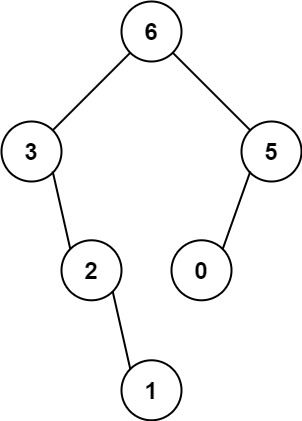
Input: nums = [3,2,1,6,0,5]
Output: [6,3,5,null,2,0,null,null,1]
Explanation: The recursive calls are as follow:
- The largest value in [3,2,1,6,0,5] is 6. Left prefix is [3,2,1] and right suffix is [0,5].
    - The largest value in [3,2,1] is 3. Left prefix is [] and right suffix is [2,1].
        - Empty array, so no child.
        - The largest value in [2,1] is 2. Left prefix is [] and right suffix is [1].
            - Empty array, so no child.
            - Only one element, so child is a node with value 1.
    - The largest value in [0,5] is 5. Left prefix is [0] and right suffix is [].
        - Only one element, so child is a node with value 0.
        - Empty array, so no child.
Example 2:
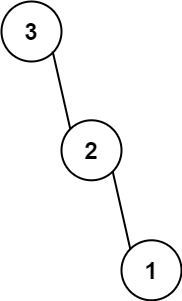
Input: nums = [3,2,1]
Output: [3,null,2,null,1]
Constraints:
1 <= nums.length <= 10000 <= nums[i] <= 1000- All integers in
numsare unique.
Solutions
Solution 1: Depth-First Search + Recursion
First find the position $i$ where the largest element of the array $nums$ is located, use $nums[i]$ as the root node, and then recurse the sub-arrays on the left and right sides to build the left and right subtrees.
The time complexity is $O(n^2)$ and the space complexity is $O(n)$, where $n$ is the length of the array.
Solution 2
In method one, it takes $O(n)$ to search for the maximum value of the interval each time. We can use the line segment tree to reduce the time to $O(\log n)$ to query the maximum value of the interval each time.
At most $n$ queries are required, so the total time complexity is $O(n \times \log n)$ and the space complexity is $O(n)$, where $n$ is the length of the array.
Solution 3
The question expresses a meaning: if there is a number $v$ in the middle of $nums$, find the largest number on the left and right sides of it. The two largest numbers should be smaller than $v$.
Friends who know the monotonic stack may notice:
When we try to push a number $v$ into the stack, if the top element of the stack is smaller than $v$, the top element of the stack is popped in a loop and the last popped element $last$ is recorded. Then the loop ends, $last$ must be on the left side of $v$, because $last$ is the largest number on the left side of $v$. Let $node(val=v).left$ point to $last$.
If there is a stack top element at this time, the stack top element must be greater than $v$. $v$ becomes the candidate right subtree node of the top element of the stack. Let $stk.top().right$ point to $v$. Then $v$ is pushed onto the stack.
At the end of the traversal, the element at the bottom of the stack becomes the root node of the tree.
Time complexity $O(n)$, space complexity $O(n)$.
Solution 4: Explicit Stack
Thinking
The root is the maximum of an interval, and both children follow the same rule. $n \le 1000$, so a linear scan for each maximum is acceptable in time. On an increasing array the maximum is always at the right end, so the first call always handles the remaining $n-1$ elements on the left and the depth is $n$, past the default recursion limit.
The root of a segment depends only on its two endpoints, so the subarray does not need to be copied.
Store pending half-open intervals $[l, r)$ on an explicit stack, together with which side of the parent they hang from. Pop an interval, scan for its maximum, create the node, then push the right interval and the left interval. An empty interval is skipped.
Scan the half-open interval $[l, r)$ for the index $i$ of the maximum, and make $nums[i]$ the root. The left child is the interval $[l, i)$ and the right child is $[i + 1, r)$. Pending intervals live on an explicit stack: after a root is created, push the right interval and then the left interval. Empty intervals are skipped. The first interval is $[0, n)$.
The time complexity is $O(n^2)$, and the space complexity is $O(n)$, where $n$ is the length of the array.
Solution 5: Segment Tree + Explicit Stack
Thinking
Solution 1 already builds the tree with an explicit stack, but each maximum is still a linear scan. A segment tree answers a range maximum in $O(\log n)$. The left interval can still form a chain of length $n$, so those two child intervals go on the same explicit stack. The total time is $O(n \log n)$.
-
/** * Definition for a binary tree node. * public class TreeNode { * int val; * TreeNode left; * TreeNode right; * TreeNode() {} * TreeNode(int val) { this.val = val; } * TreeNode(int val, TreeNode left, TreeNode right) { * this.val = val; * this.left = left; * this.right = right; * } * } */ class Solution { private int[] nums; public TreeNode constructMaximumBinaryTree(int[] nums) { this.nums = nums; return dfs(0, nums.length - 1); } private TreeNode dfs(int l, int r) { if (l > r) { return null; } int i = l; for (int j = l; j <= r; ++j) { if (nums[i] < nums[j]) { i = j; } } TreeNode root = new TreeNode(nums[i]); root.left = dfs(l, i - 1); root.right = dfs(i + 1, r); return root; } } // Solution 2 /** * Definition for a binary tree node. * public class TreeNode { * int val; * TreeNode left; * TreeNode right; * TreeNode() {} * TreeNode(int val) { this.val = val; } * TreeNode(int val, TreeNode left, TreeNode right) { * this.val = val; * this.left = left; * this.right = right; * } * } */ class Solution { private SegmentTree tree; private int[] nums; private static int[] d = new int[1010]; public TreeNode constructMaximumBinaryTree(int[] nums) { int n = nums.length; this.nums = nums; tree = new SegmentTree(nums); for (int i = 0; i < n; ++i) { d[nums[i]] = i + 1; } return dfs(1, n); } private TreeNode dfs(int l, int r) { if (l > r) { return null; } int val = tree.query(1, l, r); TreeNode root = new TreeNode(val); root.left = dfs(l, d[val] - 1); root.right = dfs(d[val] + 1, r); return root; } } class Node { int l; int r; int v; } class SegmentTree { Node[] tr; int[] nums; public SegmentTree(int[] nums) { int n = nums.length; this.nums = nums; tr = new Node[n << 2]; for (int i = 0; i < tr.length; ++i) { tr[i] = new Node(); } build(1, 1, n); } private void build(int u, int l, int r) { tr[u].l = l; tr[u].r = r; if (l == r) { tr[u].v = nums[l - 1]; return; } int mid = (l + r) >> 1; build(u << 1, l, mid); build(u << 1 | 1, mid + 1, r); pushup(u); } public int query(int u, int l, int r) { if (tr[u].l >= l && tr[u].r <= r) { return tr[u].v; } int mid = (tr[u].l + tr[u].r) >> 1; int v = 0; if (l <= mid) { v = query(u << 1, l, r); } if (r > mid) { v = Math.max(v, query(u << 1 | 1, l, r)); } return v; } private void pushup(int u) { tr[u].v = Math.max(tr[u << 1].v, tr[u << 1 | 1].v); } } // Solution 3 /** * Definition for a binary tree node. * public class TreeNode { * int val; * TreeNode left; * TreeNode right; * TreeNode() {} * TreeNode(int val) { this.val = val; } * TreeNode(int val, TreeNode left, TreeNode right) { * this.val = val; * this.left = left; * this.right = right; * } * } */ class Solution { public TreeNode constructMaximumBinaryTree(int[] nums) { Deque<TreeNode> stk = new ArrayDeque<>(); for (int v : nums) { TreeNode node = new TreeNode(v); TreeNode last = null; while (!stk.isEmpty() && stk.peek().val < v) { last = stk.pop(); } node.left = last; if (!stk.isEmpty()) { stk.peek().right = node; } stk.push(node); } return stk.getLast(); } } // Solution 4 /** * Definition for a binary tree node. * public class TreeNode { * int val; * TreeNode left; * TreeNode right; * TreeNode() {} * TreeNode(int val) { this.val = val; } * TreeNode(int val, TreeNode left, TreeNode right) { * this.val = val; * this.left = left; * this.right = right; * } * } */ class Solution { public TreeNode constructMaximumBinaryTree(int[] nums) { int n = nums.length; TreeNode root = null; Deque<Frame> stk = new ArrayDeque<>(); stk.push(new Frame(0, n - 1, null, 0)); while (!stk.isEmpty()) { Frame cur = stk.pop(); if (cur.l > cur.r) { continue; } int i = cur.l; for (int j = cur.l; j <= cur.r; ++j) { if (nums[i] < nums[j]) { i = j; } } TreeNode node = new TreeNode(nums[i]); if (cur.parent == null) { root = node; } else if (cur.side == 0) { cur.parent.left = node; } else { cur.parent.right = node; } stk.push(new Frame(i + 1, cur.r, node, 1)); stk.push(new Frame(cur.l, i - 1, node, 0)); } return root; } private static class Frame { int l, r, side; TreeNode parent; Frame(int l, int r, TreeNode parent, int side) { this.l = l; this.r = r; this.parent = parent; this.side = side; } } } // Solution 5 /** * Definition for a binary tree node. * public class TreeNode { * int val; * TreeNode left; * TreeNode right; * TreeNode() {} * TreeNode(int val) { this.val = val; } * TreeNode(int val, TreeNode left, TreeNode right) { * this.val = val; * this.left = left; * this.right = right; * } * } */ class Solution { private SegmentTree tree; private int[] nums; private static int[] d = new int[1010]; public TreeNode constructMaximumBinaryTree(int[] nums) { int n = nums.length; this.nums = nums; tree = new SegmentTree(nums); for (int i = 0; i < n; ++i) { d[nums[i]] = i + 1; } TreeNode root = null; Deque<Frame> stk = new ArrayDeque<>(); stk.push(new Frame(1, n, null, 0)); while (!stk.isEmpty()) { Frame cur = stk.pop(); if (cur.l > cur.r) { continue; } int val = tree.query(1, cur.l, cur.r); TreeNode node = new TreeNode(val); if (cur.parent == null) { root = node; } else if (cur.side == 0) { cur.parent.left = node; } else { cur.parent.right = node; } int i = d[val]; stk.push(new Frame(i + 1, cur.r, node, 1)); stk.push(new Frame(cur.l, i - 1, node, 0)); } return root; } private static class Frame { int l, r, side; TreeNode parent; Frame(int l, int r, TreeNode parent, int side) { this.l = l; this.r = r; this.parent = parent; this.side = side; } } } class Node { int l; int r; int v; } class SegmentTree { Node[] tr; int[] nums; public SegmentTree(int[] nums) { int n = nums.length; this.nums = nums; tr = new Node[n << 2]; for (int i = 0; i < tr.length; ++i) { tr[i] = new Node(); } build(1, 1, n); } private void build(int u, int l, int r) { tr[u].l = l; tr[u].r = r; if (l == r) { tr[u].v = nums[l - 1]; return; } int mid = (l + r) >> 1; build(u << 1, l, mid); build(u << 1 | 1, mid + 1, r); pushup(u); } public int query(int u, int l, int r) { if (tr[u].l >= l && tr[u].r <= r) { return tr[u].v; } int mid = (tr[u].l + tr[u].r) >> 1; int v = 0; if (l <= mid) { v = query(u << 1, l, r); } if (r > mid) { v = Math.max(v, query(u << 1 | 1, l, r)); } return v; } private void pushup(int u) { tr[u].v = Math.max(tr[u << 1].v, tr[u << 1 | 1].v); } } -
/** * Definition for a binary tree node. * struct TreeNode { * int val; * TreeNode *left; * TreeNode *right; * TreeNode() : val(0), left(nullptr), right(nullptr) {} * TreeNode(int x) : val(x), left(nullptr), right(nullptr) {} * TreeNode(int x, TreeNode *left, TreeNode *right) : val(x), left(left), right(right) {} * }; */ class Solution { public: TreeNode* constructMaximumBinaryTree(vector<int>& nums) { return dfs(nums, 0, nums.size() - 1); } TreeNode* dfs(vector<int>& nums, int l, int r) { if (l > r) return nullptr; int i = l; for (int j = l; j <= r; ++j) { if (nums[i] < nums[j]) { i = j; } } TreeNode* root = new TreeNode(nums[i]); root->left = dfs(nums, l, i - 1); root->right = dfs(nums, i + 1, r); return root; } }; // Solution 2 /** * Definition for a binary tree node. * struct TreeNode { * int val; * TreeNode *left; * TreeNode *right; * TreeNode() : val(0), left(nullptr), right(nullptr) {} * TreeNode(int x) : val(x), left(nullptr), right(nullptr) {} * TreeNode(int x, TreeNode *left, TreeNode *right) : val(x), left(left), right(right) {} * }; */ class Node { public: int l, r, v; }; class SegmentTree { public: vector<Node*> tr; vector<int> nums; SegmentTree(vector<int>& nums) { this->nums = nums; int n = nums.size(); tr.resize(n << 2); for (int i = 0; i < tr.size(); ++i) tr[i] = new Node(); build(1, 1, n); } void build(int u, int l, int r) { tr[u]->l = l; tr[u]->r = r; if (l == r) { tr[u]->v = nums[l - 1]; return; } int mid = (l + r) >> 1; build(u << 1, l, mid); build(u << 1 | 1, mid + 1, r); pushup(u); } int query(int u, int l, int r) { if (tr[u]->l >= l && tr[u]->r <= r) return tr[u]->v; int mid = (tr[u]->l + tr[u]->r) >> 1; int v = 0; if (l <= mid) v = query(u << 1, l, r); if (r > mid) v = max(v, query(u << 1 | 1, l, r)); return v; } void pushup(int u) { tr[u]->v = max(tr[u << 1]->v, tr[u << 1 | 1]->v); } }; class Solution { public: SegmentTree* tree; vector<int> nums; vector<int> d; TreeNode* constructMaximumBinaryTree(vector<int>& nums) { tree = new SegmentTree(nums); this->nums = nums; d.assign(1010, 0); int n = nums.size(); for (int i = 0; i < n; ++i) d[nums[i]] = i + 1; return dfs(1, nums.size()); } TreeNode* dfs(int l, int r) { if (l > r) { return nullptr; } int val = tree->query(1, l, r); TreeNode* root = new TreeNode(val); root->left = dfs(l, d[val] - 1); root->right = dfs(d[val] + 1, r); return root; } }; // Solution 3 /** * Definition for a binary tree node. * struct TreeNode { * int val; * TreeNode *left; * TreeNode *right; * TreeNode() : val(0), left(nullptr), right(nullptr) {} * TreeNode(int x) : val(x), left(nullptr), right(nullptr) {} * TreeNode(int x, TreeNode *left, TreeNode *right) : val(x), left(left), right(right) {} * }; */ class Solution { public: TreeNode* constructMaximumBinaryTree(vector<int>& nums) { stack<TreeNode*> stk; for (int v : nums) { TreeNode* node = new TreeNode(v); TreeNode* last = nullptr; while (!stk.empty() && stk.top()->val < v) { last = stk.top(); stk.pop(); } node->left = last; if (!stk.empty()) { stk.top()->right = node; } stk.push(node); } while (stk.size() > 1) { stk.pop(); } return stk.top(); } }; // Solution 4 /** * Definition for a binary tree node. * struct TreeNode { * int val; * TreeNode *left; * TreeNode *right; * TreeNode() : val(0), left(nullptr), right(nullptr) {} * TreeNode(int x) : val(x), left(nullptr), right(nullptr) {} * TreeNode(int x, TreeNode *left, TreeNode *right) : val(x), left(left), right(right) {} * }; */ class Solution { public: TreeNode* constructMaximumBinaryTree(vector<int>& nums) { struct Frame { int l, r, side; TreeNode* parent; }; int n = nums.size(); TreeNode* root = nullptr; vector<Frame> stk{{0, n - 1, 0, nullptr}}; while (!stk.empty()) { auto cur = stk.back(); stk.pop_back(); if (cur.l > cur.r) { continue; } int i = cur.l; for (int j = cur.l; j <= cur.r; ++j) { if (nums[i] < nums[j]) { i = j; } } TreeNode* node = new TreeNode(nums[i]); if (cur.parent == nullptr) { root = node; } else if (cur.side == 0) { cur.parent->left = node; } else { cur.parent->right = node; } stk.push_back({i + 1, cur.r, 1, node}); stk.push_back({cur.l, i - 1, 0, node}); } return root; } }; // Solution 5 /** * Definition for a binary tree node. * struct TreeNode { * int val; * TreeNode *left; * TreeNode *right; * TreeNode() : val(0), left(nullptr), right(nullptr) {} * TreeNode(int x) : val(x), left(nullptr), right(nullptr) {} * TreeNode(int x, TreeNode *left, TreeNode *right) : val(x), left(left), right(right) {} * }; */ class Node { public: int l, r, v; }; class SegmentTree { public: vector<Node*> tr; vector<int> nums; SegmentTree(vector<int>& nums) { this->nums = nums; int n = nums.size(); tr.resize(n << 2); for (int i = 0; i < tr.size(); ++i) tr[i] = new Node(); build(1, 1, n); } void build(int u, int l, int r) { tr[u]->l = l; tr[u]->r = r; if (l == r) { tr[u]->v = nums[l - 1]; return; } int mid = (l + r) >> 1; build(u << 1, l, mid); build(u << 1 | 1, mid + 1, r); pushup(u); } int query(int u, int l, int r) { if (tr[u]->l >= l && tr[u]->r <= r) return tr[u]->v; int mid = (tr[u]->l + tr[u]->r) >> 1; int v = 0; if (l <= mid) v = query(u << 1, l, r); if (r > mid) v = max(v, query(u << 1 | 1, l, r)); return v; } void pushup(int u) { tr[u]->v = max(tr[u << 1]->v, tr[u << 1 | 1]->v); } }; class Solution { public: SegmentTree* tree; vector<int> nums; vector<int> d; TreeNode* constructMaximumBinaryTree(vector<int>& nums) { tree = new SegmentTree(nums); this->nums = nums; d.assign(1010, 0); int n = nums.size(); for (int i = 0; i < n; ++i) d[nums[i]] = i + 1; struct Frame { int l, r, side; TreeNode* parent; }; TreeNode* root = nullptr; vector<Frame> stk{{1, n, 0, nullptr}}; while (!stk.empty()) { auto cur = stk.back(); stk.pop_back(); if (cur.l > cur.r) { continue; } int val = tree->query(1, cur.l, cur.r); TreeNode* node = new TreeNode(val); if (cur.parent == nullptr) { root = node; } else if (cur.side == 0) { cur.parent->left = node; } else { cur.parent->right = node; } int i = d[val]; stk.push_back({i + 1, cur.r, 1, node}); stk.push_back({cur.l, i - 1, 0, node}); } return root; } }; -
# Definition for a binary tree node. # class TreeNode: # def __init__(self, val=0, left=None, right=None): # self.val = val # self.left = left # self.right = right class Solution: def constructMaximumBinaryTree(self, nums: List[int]) -> Optional[TreeNode]: def dfs(nums): if not nums: return None val = max(nums) i = nums.index(val) root = TreeNode(val) root.left = dfs(nums[:i]) root.right = dfs(nums[i + 1 :]) return root return dfs(nums) # Solution 2 # Definition for a binary tree node. # class TreeNode: # def __init__(self, val=0, left=None, right=None): # self.val = val # self.left = left # self.right = right class Solution: def constructMaximumBinaryTree(self, nums: List[int]) -> Optional[TreeNode]: def dfs(l, r): if l > r: return None val = tree.query(1, l, r) root = TreeNode(val) root.left = dfs(l, d[val] - 1) root.right = dfs(d[val] + 1, r) return root d = {v: i for i, v in enumerate(nums, 1)} tree = SegmentTree(nums) return dfs(1, len(nums)) class Node: def __init__(self): self.l = 0 self.r = 0 self.v = 0 class SegmentTree: def __init__(self, nums): self.nums = nums n = len(nums) self.tr = [Node() for _ in range(n << 2)] self.build(1, 1, n) def build(self, u, l, r): self.tr[u].l, self.tr[u].r = l, r if l == r: self.tr[u].v = self.nums[l - 1] return mid = (l + r) >> 1 self.build(u << 1, l, mid) self.build(u << 1 | 1, mid + 1, r) self.pushup(u) def query(self, u, l, r): if self.tr[u].l >= l and self.tr[u].r <= r: return self.tr[u].v mid = (self.tr[u].l + self.tr[u].r) >> 1 v = 0 if l <= mid: v = max(v, self.query(u << 1, l, r)) if r > mid: v = max(v, self.query(u << 1 | 1, l, r)) return v def pushup(self, u): self.tr[u].v = max(self.tr[u << 1].v, self.tr[u << 1 | 1].v) # Solution 3 # Definition for a binary tree node. # class TreeNode: # def __init__(self, val=0, left=None, right=None): # self.val = val # self.left = left # self.right = right class Solution: def constructMaximumBinaryTree(self, nums: List[int]) -> Optional[TreeNode]: stk = [] for v in nums: node = TreeNode(v) last = None while stk and stk[-1].val < v: last = stk.pop() node.left = last if stk: stk[-1].right = node stk.append(node) return stk[0] # Solution 4 # Definition for a binary tree node. # class TreeNode: # def __init__(self, val=0, left=None, right=None): # self.val = val # self.left = left # self.right = right class Solution: def constructMaximumBinaryTree(self, nums: List[int]) -> Optional[TreeNode]: n = len(nums) root = None stk = [(0, n, None, 0)] while stk: l, r, parent, side = stk.pop() if l >= r: continue i = l for j in range(l + 1, r): if nums[j] > nums[i]: i = j node = TreeNode(nums[i]) if parent is None: root = node elif side == 0: parent.left = node else: parent.right = node stk.append((i + 1, r, node, 1)) stk.append((l, i, node, 0)) return root # Solution 5 # Definition for a binary tree node. # class TreeNode: # def __init__(self, val=0, left=None, right=None): # self.val = val # self.left = left # self.right = right class Solution: def constructMaximumBinaryTree(self, nums: List[int]) -> Optional[TreeNode]: d = {v: i for i, v in enumerate(nums, 1)} tree = SegmentTree(nums) root = None stk = [(1, len(nums), None, 0)] while stk: l, r, parent, side = stk.pop() if l > r: continue val = tree.query(1, l, r) node = TreeNode(val) i = d[val] if parent is None: root = node elif side == 0: parent.left = node else: parent.right = node stk.append((i + 1, r, node, 1)) stk.append((l, i - 1, node, 0)) return root class Node: def __init__(self): self.l = 0 self.r = 0 self.v = 0 class SegmentTree: def __init__(self, nums): self.nums = nums n = len(nums) self.tr = [Node() for _ in range(n << 2)] self.build(1, 1, n) def build(self, u, l, r): self.tr[u].l, self.tr[u].r = l, r if l == r: self.tr[u].v = self.nums[l - 1] return mid = (l + r) >> 1 self.build(u << 1, l, mid) self.build(u << 1 | 1, mid + 1, r) self.pushup(u) def query(self, u, l, r): if self.tr[u].l >= l and self.tr[u].r <= r: return self.tr[u].v mid = (self.tr[u].l + self.tr[u].r) >> 1 v = 0 if l <= mid: v = max(v, self.query(u << 1, l, r)) if r > mid: v = max(v, self.query(u << 1 | 1, l, r)) return v def pushup(self, u): self.tr[u].v = max(self.tr[u << 1].v, self.tr[u << 1 | 1].v) -
/** * Definition for a binary tree node. * type TreeNode struct { * Val int * Left *TreeNode * Right *TreeNode * } */ func constructMaximumBinaryTree(nums []int) *TreeNode { var dfs func(l, r int) *TreeNode dfs = func(l, r int) *TreeNode { if l > r { return nil } i := l for j := l; j <= r; j++ { if nums[i] < nums[j] { i = j } } root := &TreeNode{Val: nums[i]} root.Left = dfs(l, i-1) root.Right = dfs(i+1, r) return root } return dfs(0, len(nums)-1) } // Solution 2 /** * Definition for a binary tree node. * type TreeNode struct { * Val int * Left *TreeNode * Right *TreeNode * } */ func constructMaximumBinaryTree(nums []int) *TreeNode { d := make([]int, 1010) for i, v := range nums { d[v] = i + 1 } tree := newSegmentTree(nums) var dfs func(l, r int) *TreeNode dfs = func(l, r int) *TreeNode { if l > r { return nil } val := tree.query(1, l, r) root := &TreeNode{Val: val} root.Left = dfs(l, d[val]-1) root.Right = dfs(d[val]+1, r) return root } return dfs(1, len(nums)) } type node struct { l int r int v int } type segmentTree struct { nums []int tr []*node } func newSegmentTree(nums []int) *segmentTree { n := len(nums) tr := make([]*node, n<<2) for i := range tr { tr[i] = &node{} } t := &segmentTree{nums, tr} t.build(1, 1, n) return t } func (t *segmentTree) build(u, l, r int) { t.tr[u].l, t.tr[u].r = l, r if l == r { t.tr[u].v = t.nums[l-1] return } mid := (l + r) >> 1 t.build(u<<1, l, mid) t.build(u<<1|1, mid+1, r) t.pushup(u) } func (t *segmentTree) query(u, l, r int) int { if t.tr[u].l >= l && t.tr[u].r <= r { return t.tr[u].v } mid := (t.tr[u].l + t.tr[u].r) >> 1 v := 0 if l <= mid { v = t.query(u<<1, l, r) } if r > mid { v = max(v, t.query(u<<1|1, l, r)) } return v } func (t *segmentTree) pushup(u int) { t.tr[u].v = max(t.tr[u<<1].v, t.tr[u<<1|1].v) } // Solution 3 /** * Definition for a binary tree node. * type TreeNode struct { * Val int * Left *TreeNode * Right *TreeNode * } */ func constructMaximumBinaryTree(nums []int) *TreeNode { stk := []*TreeNode{} for _, v := range nums { node := &TreeNode{Val: v} var last *TreeNode for len(stk) > 0 && stk[len(stk)-1].Val < v { last = stk[len(stk)-1] stk = stk[:len(stk)-1] } node.Left = last if len(stk) > 0 { stk[len(stk)-1].Right = node } stk = append(stk, node) } return stk[0] } // Solution 4 /** * Definition for a binary tree node. * type TreeNode struct { * Val int * Left *TreeNode * Right *TreeNode * } */ func constructMaximumBinaryTree(nums []int) *TreeNode { type frame struct { l, r, side int parent *TreeNode } n := len(nums) var root *TreeNode stk := []frame{{0, n - 1, 0, nil}} for len(stk) > 0 { cur := stk[len(stk)-1] stk = stk[:len(stk)-1] if cur.l > cur.r { continue } i := cur.l for j := cur.l; j <= cur.r; j++ { if nums[j] > nums[i] { i = j } } node := &TreeNode{Val: nums[i]} if cur.parent == nil { root = node } else if cur.side == 0 { cur.parent.Left = node } else { cur.parent.Right = node } stk = append(stk, frame{i + 1, cur.r, 1, node}, frame{cur.l, i - 1, 0, node}) } return root } // Solution 5 /** * Definition for a binary tree node. * type TreeNode struct { * Val int * Left *TreeNode * Right *TreeNode * } */ func constructMaximumBinaryTree(nums []int) *TreeNode { d := make([]int, 1010) for i, v := range nums { d[v] = i + 1 } tree := newSegmentTree(nums) type frame struct { l, r, side int parent *TreeNode } var root *TreeNode stk := []frame{{1, len(nums), 0, nil}} for len(stk) > 0 { cur := stk[len(stk)-1] stk = stk[:len(stk)-1] if cur.l > cur.r { continue } val := tree.query(1, cur.l, cur.r) node := &TreeNode{Val: val} if cur.parent == nil { root = node } else if cur.side == 0 { cur.parent.Left = node } else { cur.parent.Right = node } i := d[val] stk = append(stk, frame{i + 1, cur.r, 1, node}, frame{cur.l, i - 1, 0, node}) } return root } type node struct { l int r int v int } type segmentTree struct { nums []int tr []*node } func newSegmentTree(nums []int) *segmentTree { n := len(nums) tr := make([]*node, n<<2) for i := range tr { tr[i] = &node{} } t := &segmentTree{nums, tr} t.build(1, 1, n) return t } func (t *segmentTree) build(u, l, r int) { t.tr[u].l, t.tr[u].r = l, r if l == r { t.tr[u].v = t.nums[l-1] return } mid := (l + r) >> 1 t.build(u<<1, l, mid) t.build(u<<1|1, mid+1, r) t.pushup(u) } func (t *segmentTree) query(u, l, r int) int { if t.tr[u].l >= l && t.tr[u].r <= r { return t.tr[u].v } mid := (t.tr[u].l + t.tr[u].r) >> 1 v := 0 if l <= mid { v = t.query(u<<1, l, r) } if r > mid { v = max(v, t.query(u<<1|1, l, r)) } return v } func (t *segmentTree) pushup(u int) { t.tr[u].v = max(t.tr[u<<1].v, t.tr[u<<1|1].v) } -
/** * Definition for a binary tree node. * class TreeNode { * val: number * left: TreeNode | null * right: TreeNode | null * constructor(val?: number, left?: TreeNode | null, right?: TreeNode | null) { * this.val = (val===undefined ? 0 : val) * this.left = (left===undefined ? null : left) * this.right = (right===undefined ? null : right) * } * } */ function constructMaximumBinaryTree(nums: number[]): TreeNode | null { const n = nums.length; if (n === 0) { return null; } const [val, i] = nums.reduce((r, v, i) => (r[0] < v ? [v, i] : r), [-1, 0]); return new TreeNode( val, constructMaximumBinaryTree(nums.slice(0, i)), constructMaximumBinaryTree(nums.slice(i + 1)), ); } // Solution 4 /** * Definition for a binary tree node. * class TreeNode { * val: number * left: TreeNode | null * right: TreeNode | null * constructor(val?: number, left?: TreeNode | null, right?: TreeNode | null) { * this.val = (val===undefined ? 0 : val) * this.left = (left===undefined ? null : left) * this.right = (right===undefined ? null : right) * } * } */ function constructMaximumBinaryTree(nums: number[]): TreeNode | null { const n = nums.length; let root: TreeNode | null = null; const stk: [number, number, TreeNode | null, number][] = [[0, n, null, 0]]; while (stk.length) { const [l, r, parent, side] = stk.pop()!; if (l >= r) { continue; } let i = l; for (let j = l + 1; j < r; ++j) { if (nums[j] > nums[i]) { i = j; } } const node = new TreeNode(nums[i]); if (parent === null) { root = node; } else if (side === 0) { parent.left = node; } else { parent.right = node; } stk.push([i + 1, r, node, 1]); stk.push([l, i, node, 0]); } return root; } -
// Definition for a binary tree node. // #[derive(Debug, PartialEq, Eq)] // pub struct TreeNode { // pub val: i32, // pub left: Option<Rc<RefCell<TreeNode>>>, // pub right: Option<Rc<RefCell<TreeNode>>>, // } // // impl TreeNode { // #[inline] // pub fn new(val: i32) -> Self { // TreeNode { // val, // left: None, // right: None // } // } // } use std::rc::Rc; use std::cell::RefCell; impl Solution { fn construct(nums: &Vec<i32>, start: usize, end: usize) -> Option<Rc<RefCell<TreeNode>>> { if start >= end { return None; } let mut idx = 0; let mut max_val = -1; for i in start..end { if nums[i] > max_val { idx = i; max_val = nums[i]; } } Some( Rc::new( RefCell::new(TreeNode { val: max_val, left: Self::construct(nums, start, idx), right: Self::construct(nums, idx + 1, end), }) ) ) } pub fn construct_maximum_binary_tree(nums: Vec<i32>) -> Option<Rc<RefCell<TreeNode>>> { Self::construct(&nums, 0, nums.len()) } } // Solution 4 // Definition for a binary tree node. // #[derive(Debug, PartialEq, Eq)] // pub struct TreeNode { // pub val: i32, // pub left: Option<Rc<RefCell<TreeNode>>>, // pub right: Option<Rc<RefCell<TreeNode>>>, // } // // impl TreeNode { // #[inline] // pub fn new(val: i32) -> Self { // TreeNode { // val, // left: None, // right: None // } // } // } use std::cell::RefCell; use std::rc::Rc; impl Solution { pub fn construct_maximum_binary_tree(nums: Vec<i32>) -> Option<Rc<RefCell<TreeNode>>> { let n = nums.len(); let mut root: Option<Rc<RefCell<TreeNode>>> = None; let mut stk: Vec<(usize, usize, Option<Rc<RefCell<TreeNode>>>, u8)> = vec![(0, n, None, 0)]; while let Some((l, r, parent, side)) = stk.pop() { if l >= r { continue; } let mut idx = l; for i in l + 1..r { if nums[i] > nums[idx] { idx = i; } } let node = Rc::new(RefCell::new(TreeNode { val: nums[idx], left: None, right: None, })); if let Some(p) = parent { if side == 0 { p.borrow_mut().left = Some(Rc::clone(&node)); } else { p.borrow_mut().right = Some(Rc::clone(&node)); } } else { root = Some(Rc::clone(&node)); } stk.push((idx + 1, r, Some(Rc::clone(&node)), 1)); stk.push((l, idx, Some(Rc::clone(&node)), 0)); } root } } -
/**
 * Definition for a binary tree node.
 * struct TreeNode {
 *     int val;
 *     struct TreeNode *left;
 *     struct TreeNode *right;
 * };
 */

struct TreeNode* construct(int* nums, int start, int end) {
    if (start >= end) {
        return NULL;
    }
    int idx = 0;
    int maxVal = -1;
    for (int i = start; i < end; i++) {
        if (nums[i] > maxVal) {
            idx = i;
            maxVal = nums[i];
        }
    }
    struct TreeNode* res = (struct TreeNode*) malloc(sizeof(struct TreeNode));
    res->val = maxVal;
    res->left = construct(nums, start, idx);
    res->right = construct(nums, idx + 1, end);
    return res;
}

struct TreeNode* constructMaximumBinaryTree(int* nums, int numsSize) {
    return construct(nums, 0, numsSize);
}

// Solution 4
/**
 * Definition for a binary tree node.
 * struct TreeNode {
 *     int val;
 *     struct TreeNode *left;
 *     struct TreeNode *right;
 * };
 */

struct TreeNode* constructMaximumBinaryTree(int* nums, int numsSize) {
    typedef struct {
        int l, r, side;
        struct TreeNode* parent;
    } Frame;
    Frame* stk = (Frame*) malloc(sizeof(Frame) * (numsSize * 2 + 5));
    int top = 0;
    stk[top++] = (Frame) {0, numsSize, 0, NULL};
    struct TreeNode* root = NULL;
    while (top) {
        Frame cur = stk[--top];
        if (cur.l >= cur.r) {
            continue;
        }
        int idx = cur.l;
        for (int i = cur.l + 1; i < cur.r; ++i) {
            if (nums[i] > nums[idx]) {
                idx = i;
            }
        }
        struct TreeNode* node = (struct TreeNode*) malloc(sizeof(struct TreeNode));
        node->val = nums[idx];
        node->left = node->right = NULL;
        if (cur.parent == NULL) {
            root = node;
        } else if (cur.side == 0) {
            cur.parent->left = node;
        } else {
            cur.parent->right = node;
        }
        stk[top++] = (Frame) {idx + 1, cur.r, 1, node};
        stk[top++] = (Frame) {cur.l, idx, 0, node};
    }
    free(stk);
    return root;
}