Welcome to Subscribe On Youtube
547. Number of Provinces
Description
There are n cities. Some of them are connected, while some are not. If city a is connected directly with city b, and city b is connected directly with city c, then city a is connected indirectly with city c.
A province is a group of directly or indirectly connected cities and no other cities outside of the group.
You are given an n x n matrix isConnected where isConnected[i][j] = 1 if the ith city and the jth city are directly connected, and isConnected[i][j] = 0 otherwise.
Return the total number of provinces.
Example 1:
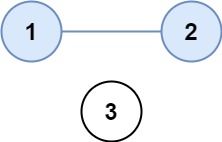
Input: isConnected = [[1,1,0],[1,1,0],[0,0,1]]
Output: 2
Example 2:
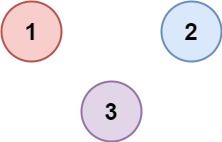
Input: isConnected = [[1,0,0],[0,1,0],[0,0,1]]
Output: 3
Constraints:
1 <= n <= 200n == isConnected.lengthn == isConnected[i].lengthisConnected[i][j]is1or0.isConnected[i][i] == 1isConnected[i][j] == isConnected[j][i]
Solutions
Solution 1: DFS
We create an array $\textit{vis}$ to record whether each city has been visited.
Next, we traverse each city $i$. If the city has not been visited, we start a depth-first search from that city. Using the matrix $\textit{isConnected}$, we find the cities directly connected to this city. These cities and the current city belong to the same province. We continue the depth-first search for these cities until all cities in the same province have been visited. This counts as one province, so we increment the answer $\textit{ans}$ by $1$. Then, we move to the next unvisited city and repeat the process until all cities have been traversed.
Finally, return the answer.
The time complexity is $O(n^2)$, and the space complexity is $O(n)$. Here, $n$ is the number of cities.
Solution 2: Union-Find
We can also use the union-find data structure to maintain each connected component. Initially, each city belongs to a different connected component, so the number of provinces is $n$.
Next, we traverse the matrix $\textit{isConnected}$. If there is a connection between two cities $(i, j)$ and they belong to two different connected components, they will be merged into one connected component, and the number of provinces is decremented by $1$.
Finally, return the number of provinces.
The time complexity is $O(n^2 \times \log n)$, and the space complexity is $O(n)$. Here, $n$ is the number of cities, and $\log n$ is the time complexity of path compression in the union-find data structure.
-
class Solution { private int[][] g; private boolean[] vis; public int findCircleNum(int[][] isConnected) { g = isConnected; int n = g.length; vis = new boolean[n]; int ans = 0; for (int i = 0; i < n; ++i) { if (!vis[i]) { dfs(i); ++ans; } } return ans; } private void dfs(int i) { vis[i] = true; for (int j = 0; j < g.length; ++j) { if (!vis[j] && g[i][j] == 1) { dfs(j); } } } } // Solution 2 class Solution { private int[] p; public int findCircleNum(int[][] isConnected) { int n = isConnected.length; p = new int[n]; for (int i = 0; i < n; ++i) { p[i] = i; } int ans = n; for (int i = 0; i < n; ++i) { for (int j = i + 1; j < n; ++j) { if (isConnected[i][j] == 1) { int pa = find(i), pb = find(j); if (pa != pb) { p[pa] = pb; --ans; } } } } return ans; } private int find(int x) { if (p[x] != x) { p[x] = find(p[x]); } return p[x]; } } -
class Solution { public: int findCircleNum(vector<vector<int>>& isConnected) { int n = isConnected.size(); int ans = 0; bool vis[n]; memset(vis, false, sizeof(vis)); function<void(int)> dfs = [&](int i) { vis[i] = true; for (int j = 0; j < n; ++j) { if (!vis[j] && isConnected[i][j]) { dfs(j); } } }; for (int i = 0; i < n; ++i) { if (!vis[i]) { dfs(i); ++ans; } } return ans; } }; // Solution 2 class Solution { public: int findCircleNum(vector<vector<int>>& isConnected) { int n = isConnected.size(); int p[n]; iota(p, p + n, 0); auto find = [&](this auto&& find, int x) -> int { if (p[x] != x) { p[x] = find(p[x]); } return p[x]; }; int ans = n; for (int i = 0; i < n; ++i) { for (int j = i + 1; j < n; ++j) { if (isConnected[i][j]) { int pa = find(i), pb = find(j); if (pa != pb) { p[pa] = pb; --ans; } } } } return ans; } }; -
class Solution: def findCircleNum(self, isConnected: List[List[int]]) -> int: def dfs(i: int): vis[i] = True for j, x in enumerate(isConnected[i]): if not vis[j] and x: dfs(j) n = len(isConnected) vis = [False] * n ans = 0 for i in range(n): if not vis[i]: dfs(i) ans += 1 return ans # Solution 2 class Solution: def findCircleNum(self, isConnected: List[List[int]]) -> int: def find(x: int) -> int: if p[x] != x: p[x] = find(p[x]) return p[x] n = len(isConnected) p = list(range(n)) ans = n for i in range(n): for j in range(i + 1, n): if isConnected[i][j]: pa, pb = find(i), find(j) if pa != pb: p[pa] = pb ans -= 1 return ans -
func findCircleNum(isConnected [][]int) (ans int) { n := len(isConnected) vis := make([]bool, n) var dfs func(int) dfs = func(i int) { vis[i] = true for j, x := range isConnected[i] { if !vis[j] && x == 1 { dfs(j) } } } for i, v := range vis { if !v { ans++ dfs(i) } } return } // Solution 2 func findCircleNum(isConnected [][]int) (ans int) { n := len(isConnected) p := make([]int, n) for i := range p { p[i] = i } var find func(x int) int find = func(x int) int { if p[x] != x { p[x] = find(p[x]) } return p[x] } ans = n for i := 0; i < n; i++ { for j := 0; j < n; j++ { if isConnected[i][j] == 1 { pa, pb := find(i), find(j) if pa != pb { p[pa] = pb ans-- } } } } return } -
function findCircleNum(isConnected: number[][]): number { const n = isConnected.length; const vis: boolean[] = new Array(n).fill(false); const dfs = (i: number) => { vis[i] = true; for (let j = 0; j < n; ++j) { if (!vis[j] && isConnected[i][j]) { dfs(j); } } }; let ans = 0; for (let i = 0; i < n; ++i) { if (!vis[i]) { dfs(i); ++ans; } } return ans; } // Solution 2 function findCircleNum(isConnected: number[][]): number { const n = isConnected.length; const p: number[] = Array.from({ length: n }, (_, i) => i); const find = (x: number): number => { if (p[x] !== x) { p[x] = find(p[x]); } return p[x]; }; let ans = n; for (let i = 0; i < n; ++i) { for (let j = i + 1; j < n; ++j) { if (isConnected[i][j]) { const pa = find(i); const pb = find(j); if (pa !== pb) { p[pa] = pb; --ans; } } } } return ans; } -
impl Solution {
    fn dfs(is_connected: &mut Vec<Vec<i32>>, vis: &mut Vec<bool>, i: usize) {
        vis[i] = true;
        for j in 0..is_connected.len() {
            if vis[j] || is_connected[i][j] == 0 {
                continue;
            }
            Self::dfs(is_connected, vis, j);
        }
    }

    pub fn find_circle_num(mut is_connected: Vec<Vec<i32>>) -> i32 {
        let n = is_connected.len();
        let mut vis = vec![false; n];
        let mut res = 0;
        for i in 0..n {
            if vis[i] {
                continue;
            }
            res += 1;
            Self::dfs(&mut is_connected, &mut vis, i);
        }
        res
    }
}