Welcome to Subscribe On Youtube
3902. Zigzag Level Sum of Binary Tree 🔒
Description
You are given the root of a binary tree.
Traverse the tree level by level using a zigzag pattern:
- At odd-numbered levels (1-indexed), traverse nodes from left to right.
- At even-numbered levels, traverse nodes from right to left.
While traversing a level in the specified direction, process nodes in order and stop immediately before the first node that violates the condition:
- At odd levels: the node does not have a left child.
- At even levels: the node does not have a right child.
Only the nodes processed before this stopping condition contribute to the level sum.
Return an integer array ans where ans[i] is the sum of the node values that are processed at level i + 1.
Example 1:
Input: root = [5,2,8,1,null,9,6]
Output: [5,8,0]
Explanation:
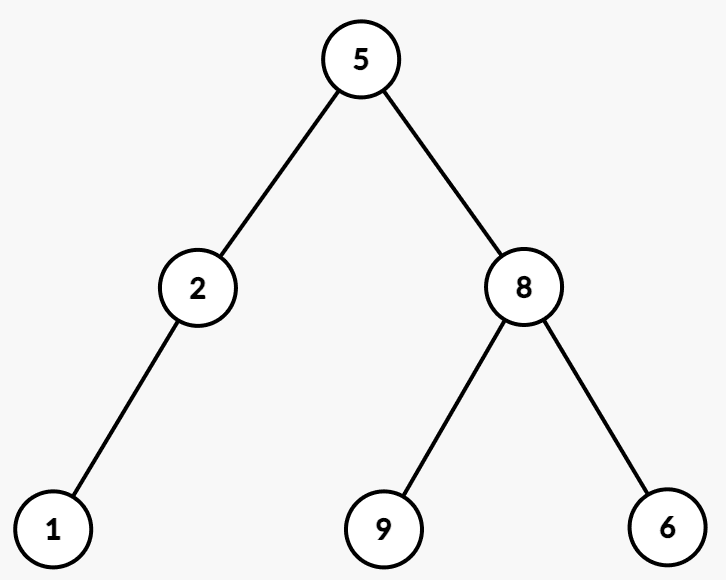
- At level 1, nodes are processed left to right. Node 5 is included, thus
ans[0] = 5. - At level 2, nodes are processed right to left. Node 8 is included, but node 2 lacks a right child, so processing stops, thus
ans[1] = 8. - At level 3, nodes are processed left to right. The first node 1 lacks a left child, so no nodes are included, and
ans[2] = 0. - Thus,
ans = [5, 8, 0].
Example 2:
Input: root = [1,2,3,4,5,null,7]
Output: [1,5,0]
Explanation:
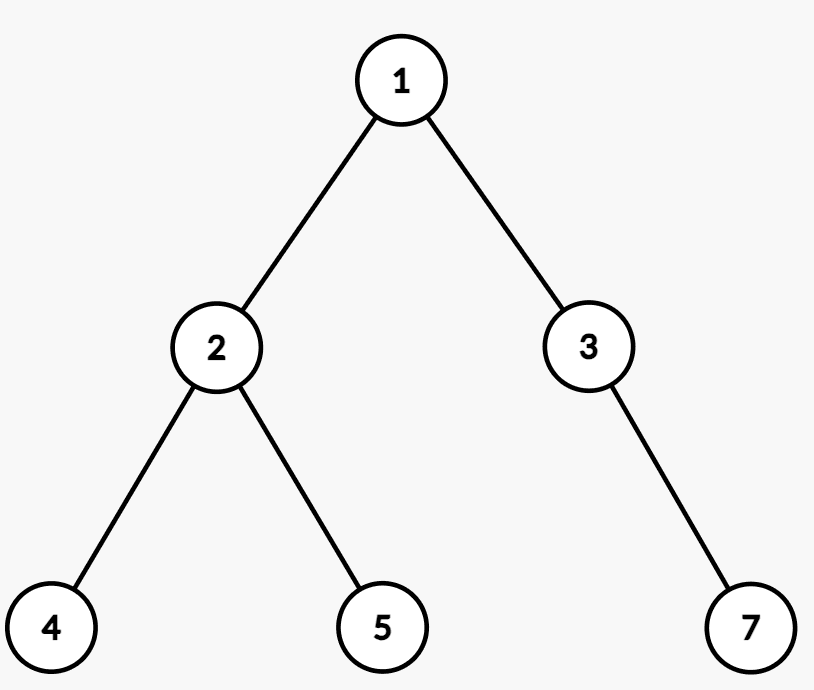
- At level 1, nodes are processed left to right. Node 1 is included, thus
ans[0] = 1. - At level 2, nodes are processed right to left. Nodes 3 and 2 are included since both have right children, thus
ans[1] = 3 + 2 = 5. - At level 3, nodes are processed left to right. The first node 4 lacks a left child, so no nodes are included, and
ans[2] = 0. - Thus,
ans = [1, 5, 0].
Constraints:
- The number of nodes in the tree is in the range
[1, 105]. -105 <= Node.val <= 105
Solutions
Solution 1: BFS
We use a queue $q$ to perform a level-order traversal, and define a boolean variable $\textit{left}$ to indicate the traversal direction of the current level. For each level, we first add the nodes of the next level to the queue $nq$, and then compute the sum of the node values of the current level, denoted by $s$, according to the value of $\textit{left}$, and append $s$ to the answer array. Finally, we update the value of $\textit{left}$ and assign $nq$ to $q$ to continue traversing the next level.
The time complexity is $O(n)$, and the space complexity is $O(n)$. Here, $n$ is the number of nodes in the binary tree.
-
/** * Definition for a binary tree node. * public class TreeNode { * int val; * TreeNode left; * TreeNode right; * TreeNode() {} * TreeNode(int val) { this.val = val; } * TreeNode(int val, TreeNode left, TreeNode right) { * this.val = val; * this.left = left; * this.right = right; * } * } */ class Solution { public List<Long> zigzagLevelSum(TreeNode root) { List<Long> ans = new ArrayList<>(); List<TreeNode> q = new ArrayList<>(); q.add(root); boolean left = true; while (!q.isEmpty()) { List<TreeNode> nq = new ArrayList<>(); for (TreeNode node : q) { if (node.left != null) { nq.add(node.left); } if (node.right != null) { nq.add(node.right); } } int m = q.size(); long s = 0; for (int i = 0; i < m; i++) { TreeNode node = left ? q.get(i) : q.get(m - i - 1); TreeNode child = left ? node.left : node.right; if (child == null) { break; } s += node.val; } ans.add(s); left = !left; q = nq; } return ans; } } -
/** * Definition for a binary tree node. * struct TreeNode { * int val; * TreeNode *left; * TreeNode *right; * TreeNode() : val(0), left(nullptr), right(nullptr) {} * TreeNode(int x) : val(x), left(nullptr), right(nullptr) {} * TreeNode(int x, TreeNode *left, TreeNode *right) : val(x), left(left), right(right) {} * }; */ class Solution { public: vector<long long> zigzagLevelSum(TreeNode* root) { vector<long long> ans; vector<TreeNode*> q = {root}; bool left = true; while (!q.empty()) { vector<TreeNode*> nq; for (TreeNode* node : q) { if (node->left != nullptr) { nq.push_back(node->left); } if (node->right != nullptr) { nq.push_back(node->right); } } int m = q.size(); long long s = 0; for (int i = 0; i < m; i++) { TreeNode* node = left ? q[i] : q[m - i - 1]; TreeNode* child = left ? node->left : node->right; if (child == nullptr) { break; } s += node->val; } ans.push_back(s); left = !left; q = nq; } return ans; } }; -
# Definition for a binary tree node. # class TreeNode: # def __init__(self, val=0, left=None, right=None): # self.val = val # self.left = left # self.right = right class Solution: def zigzagLevelSum(self, root: TreeNode | None) -> list[int]: q = [root] ans = [] left = True while q: nq = [] for node in q: if node.left: nq.append(node.left) if node.right: nq.append(node.right) m = len(q) s = 0 for i in range(m): node = q[i] if left else q[m - i - 1] child = node.left if left else node.right if not child: break s += node.val ans.append(s) left = not left q = nq return ans -
/** * Definition for a binary tree node. * type TreeNode struct { * Val int * Left *TreeNode * Right *TreeNode * } */ func zigzagLevelSum(root *TreeNode) []int64 { ans := []int64{} q := []*TreeNode{root} left := true for len(q) > 0 { nq := []*TreeNode{} for _, node := range q { if node.Left != nil { nq = append(nq, node.Left) } if node.Right != nil { nq = append(nq, node.Right) } } m := len(q) var s int64 = 0 for i := 0; i < m; i++ { var node *TreeNode if left { node = q[i] } else { node = q[m-i-1] } var child *TreeNode if left { child = node.Left } else { child = node.Right } if child == nil { break } s += int64(node.Val) } ans = append(ans, s) left = !left q = nq } return ans } -
/**
 * Definition for a binary tree node.
 * class TreeNode {
 *     val: number
 *     left: TreeNode | null
 *     right: TreeNode | null
 *     constructor(val?: number, left?: TreeNode | null, right?: TreeNode | null) {
 *         this.val = (val===undefined ? 0 : val)
 *         this.left = (left===undefined ? null : left)
 *         this.right = (right===undefined ? null : right)
 *     }
 * }
 */
function zigzagLevelSum(root: TreeNode | null): number[] {
    let q: TreeNode[] = [root];
    const ans: number[] = [];
    let left = true;
    while (q.length > 0) {
        const nq: TreeNode[] = [];
        for (const { left, right } of q) {
            if (left !== null) {
                nq.push(left);
            }
            if (right !== null) {
                nq.push(right);
            }
        }
        const m = q.length;
        let s = 0;
        for (let i = 0; i < m; i++) {
            const node = left ? q[i] : q[m - i - 1];
            const child = left ? node.left : node.right;
            if (child === null) {
                break;
            }
            s += node.val;
        }
        ans.push(s);
        left = !left;
        q = nq;
    }
    return ans;
}