Welcome to Subscribe On Youtube
3620. Network Recovery Pathways
Description
You are given a directed acyclic graph of n nodes numbered from 0 to n − 1. This is represented by a 2D array edges of length m, where edges[i] = [ui, vi, costi] indicates a one‑way communication from node ui to node vi with a recovery cost of costi.
Some nodes may be offline. You are given a boolean array online where online[i] = true means node i is online. Nodes 0 and n − 1 are always online.
A path from 0 to n − 1 is valid if:
- All intermediate nodes on the path are online.
- The total recovery cost of all edges on the path does not exceed
k.
For each valid path, define its score as the minimum edge‑cost along that path.
Return the maximum path score (i.e., the largest minimum-edge cost) among all valid paths. If no valid path exists, return -1.
Example 1:
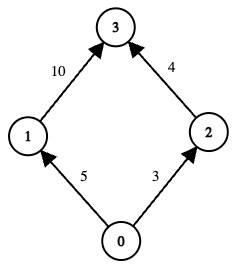
Input: edges = [[0,1,5],[1,3,10],[0,2,3],[2,3,4]], online = [true,true,true,true], k = 10
Output: 3
Explanation:
-
The graph has two possible routes from node 0 to node 3:
-
Path
0 → 1 → 3-
Total cost =
5 + 10 = 15, which exceeds k (15 > 10), so this path is invalid.
-
-
Path
0 → 2 → 3-
Total cost =
3 + 4 = 7 <= k, so this path is valid. -
The minimum edge‐cost along this path is
min(3, 4) = 3.
-
-
-
There are no other valid paths. Hence, the maximum among all valid path‐scores is 3.
Example 2:
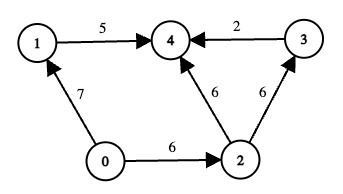
Input: edges = [[0,1,7],[1,4,5],[0,2,6],[2,3,6],[3,4,2],[2,4,6]], online = [true,true,true,false,true], k = 12
Output: 6
Explanation:
-
Node 3 is offline, so any path passing through 3 is invalid.
-
Consider the remaining routes from 0 to 4:
-
Path
0 → 1 → 4-
Total cost =
7 + 5 = 12 <= k, so this path is valid. -
The minimum edge‐cost along this path is
min(7, 5) = 5.
-
-
Path
0 → 2 → 3 → 4-
Node 3 is offline, so this path is invalid regardless of cost.
-
-
Path
0 → 2 → 4-
Total cost =
6 + 6 = 12 <= k, so this path is valid. -
The minimum edge‐cost along this path is
min(6, 6) = 6.
-
-
-
Among the two valid paths, their scores are 5 and 6. Therefore, the answer is 6.
Constraints:
n == online.length2 <= n <= 5 * 1040 <= m == edges.length <=min(105, n * (n - 1) / 2)edges[i] = [ui, vi, costi]0 <= ui, vi < nui != vi0 <= costi <= 1090 <= k <= 5 * 1013online[i]is eithertrueorfalse, and bothonline[0]andonline[n − 1]aretrue.- The given graph is a directed acyclic graph.
Solutions
Solution 1
-
class Solution { int n; List<int[]>[] g; long k; boolean check(int mid) { long[] dist = new long[n]; Arrays.fill(dist, Long.MAX_VALUE / 4); dist[0] = 0; PriorityQueue<long[]> pq = new PriorityQueue<>(Comparator.comparingLong(a -> a[0])); pq.offer(new long[] {0, 0}); while (!pq.isEmpty()) { long[] cur = pq.poll(); long d = cur[0]; int u = (int) cur[1]; if (d > k) return false; if (u == n - 1) return true; if (dist[u] < d) continue; for (int[] e : g[u]) { int v = e[0], w = e[1]; if (w < mid) continue; long nd = d + w; if (nd < dist[v]) { dist[v] = nd; pq.offer(new long[] {nd, v}); } } } return false; } public int findMaxPathScore(int[][] edges, boolean[] online, long k) { this.k = k; n = online.length; g = new ArrayList[n]; for (int i = 0; i < n; i++) g[i] = new ArrayList<>(); int l = Integer.MAX_VALUE; int r = 0; for (int[] e : edges) { int u = e[0], v = e[1], w = e[2]; if (!online[u] || !online[v]) continue; g[u].add(new int[] {v, w}); l = Math.min(l, w); r = Math.max(r, w); } while (l < r) { int mid = (l + r + 1) >>> 1; if (check(mid)) l = mid; else r = mid - 1; } return check(l) ? l : -1; } } -
class Solution { public: int findMaxPathScore(vector<vector<int>>& edges, vector<bool>& online, long long k) { int n = online.size(); vector<vector<pair<int, int>>> g(n); int l = INT_MAX, r = 0; for (auto& e : edges) { int u = e[0], v = e[1], w = e[2]; if (!online[u] || !online[v]) continue; g[u].push_back({v, w}); l = min(l, w); r = max(r, w); } auto check = [&](int mid) -> bool { vector<long long> dist(n, LLONG_MAX / 4); dist[0] = 0; using P = pair<long long, int>; priority_queue<P, vector<P>, greater<P>> pq; pq.push({0, 0}); while (!pq.empty()) { auto [d, u] = pq.top(); pq.pop(); if (d > k) return false; if (u == n - 1) return true; if (dist[u] < d) continue; for (auto& ed : g[u]) { int v = ed.first, w = ed.second; if (w < mid) continue; long long nd = d + w; if (nd < dist[v]) { dist[v] = nd; pq.push({nd, v}); } } } return false; }; while (l < r) { int mid = (l + r + 1) >> 1; if (check(mid)) l = mid; else r = mid - 1; } return check(l) ? l : -1; } }; -
class Solution: def findMaxPathScore( self, edges: List[List[int]], online: List[bool], k: int ) -> int: def check(mid: int) -> int: dist = [inf] * n dist[0] = 0 pq = [(0, 0)] while pq: d, u = heappop(pq) if d > k: return False if u == n - 1: return True if dist[u] < d: continue for v, w in g[u]: if w < mid: continue if dist[u] + w < dist[v]: dist[v] = dist[u] + w heappush(pq, (dist[v], v)) return False n = len(online) g = [[] for _ in range(n)] l, r = inf, 0 for ( u, v, w, ) in edges: if not online[u] or not online[v]: continue g[u].append((v, w)) l = min(l, w) r = max(r, w) while l < r: mid = (l + r + 1) >> 1 if check(mid): l = mid else: r = mid - 1 return l if check(l) else -1 -
type Item struct { d int u int } type H []Item func (h H) Len() int { return len(h) } func (h H) Less(i, j int) bool { return h[i].d < h[j].d } func (h H) Swap(i, j int) { h[i], h[j] = h[j], h[i] } func (h *H) Push(x any) { *h = append(*h, x.(Item)) } func (h *H) Pop() any { x := (*h)[len(*h)-1]; *h = (*h)[:len(*h)-1]; return x } func findMaxPathScore(edges [][]int, online []bool, k int64) int { n := len(online) g := make([][][]int, n) l, r := int(^uint(0)>>1), 0 for _, e := range edges { u, v, w := e[0], e[1], e[2] if !online[u] || !online[v] { continue } g[u] = append(g[u], []int{v, w}) if w < l { l = w } if w > r { r = w } } check := func(mid int) bool { const INF = int(^uint(0) >> 1) dist := make([]int, n) for i := range dist { dist[i] = INF } dist[0] = 0 h := &H{} heap.Push(h, Item{0, 0}) for h.Len() > 0 { cur := heap.Pop(h).(Item) d, u := cur.d, cur.u if int64(d) > k { return false } if u == n-1 { return true } if dist[u] < d { continue } for _, e := range g[u] { v, w := e[0], e[1] if w < mid { continue } nd := d + w if nd < dist[v] { dist[v] = nd heap.Push(h, Item{nd, v}) } } } return false } for l < r { mid := (l + r + 1) >> 1 if check(mid) { l = mid } else { r = mid - 1 } } if check(l) { return l } return -1 } -
function findMaxPathScore(edges: number[][], online: boolean[], k: number): number {
    const n = online.length;
    const g: [number, number][][] = Array.from({ length: n }, () => []);

    let l = Number.MAX_SAFE_INTEGER;
    let r = 0;

    for (const [u, v, w] of edges) {
        if (!online[u] || !online[v]) continue;
        g[u].push([v, w]);
        l = Math.min(l, w);
        r = Math.max(r, w);
    }

    const check = (mid: number): boolean => {
        const INF = Number.MAX_SAFE_INTEGER / 2;
        const dist = new Array<number>(n).fill(INF);
        dist[0] = 0;

        const pq = new PriorityQueue<[number, number]>((a, b) => a[0] - b[0]);
        pq.enqueue([0, 0]);

        while (!pq.isEmpty()) {
            const [d, u] = pq.dequeue();

            if (d > k) return false;
            if (u === n - 1) return true;
            if (dist[u] < d) continue;

            for (const [v, w] of g[u]) {
                if (w < mid) continue;

                const nd = d + w;
                if (nd < dist[v]) {
                    dist[v] = nd;
                    pq.enqueue([nd, v]);
                }
            }
        }

        return false;
    };

    while (l < r) {
        const mid = (l + r + 1) >> 1;
        if (check(mid)) l = mid;
        else r = mid - 1;
    }

    return check(l) ? l : -1;
}