Welcome to Subscribe On Youtube
3331. Find Subtree Sizes After Changes
Description
You are given a tree rooted at node 0 that consists of n nodes numbered from 0 to n - 1. The tree is represented by an array parent of size n, where parent[i] is the parent of node i. Since node 0 is the root, parent[0] == -1.
You are also given a string s of length n, where s[i] is the character assigned to node i.
We make the following changes on the tree one time simultaneously for all nodes x from 1 to n - 1:
- Find the closest node
yto nodexsuch thatyis an ancestor ofx, ands[x] == s[y]. - If node
ydoes not exist, do nothing. - Otherwise, remove the edge between
xand its current parent and make nodeythe new parent ofxby adding an edge between them.
Return an array answer of size n where answer[i] is the size of the subtree rooted at node i in the final tree.
Example 1:
Input: parent = [-1,0,0,1,1,1], s = "abaabc"
Output: [6,3,1,1,1,1]
Explanation:
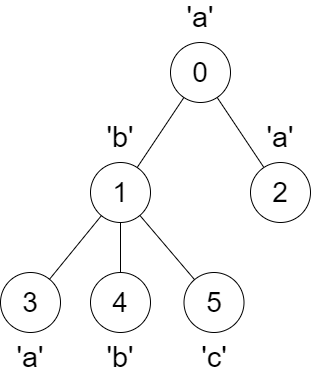
The parent of node 3 will change from node 1 to node 0.
Example 2:
Input: parent = [-1,0,4,0,1], s = "abbba"
Output: [5,2,1,1,1]
Explanation:
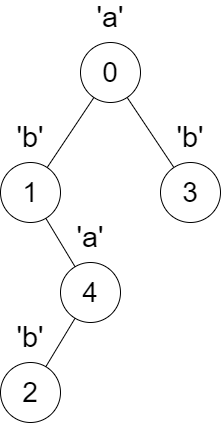
The following changes will happen at the same time:
- The parent of node 4 will change from node 1 to node 0.
- The parent of node 2 will change from node 4 to node 1.
Constraints:
n == parent.length == s.length1 <= n <= 1050 <= parent[i] <= n - 1for alli >= 1.parent[0] == -1parentrepresents a valid tree.sconsists only of lowercase English letters.
Solutions
Solution 1
Solution 2: Explicit Stack
Thinking
A node may be reattached under its nearest ancestor with the same letter. $n$ can reach $10^5$, so rebuilding the edge list and then recounting subtrees is unnecessary. On a chain the first recursive call always follows the only child, so the depth is $n$ and exceeds the default recursion limit.
A subtree size can be added to its new parent only after every descendant has been counted, and a same-letter ancestor lies on the current path.
An explicit stack walks the tree in postorder, while $\textit{d}[c]$ stores the nodes of letter $c$ still on the path. On entry, set the node’s size to $1$, push it onto its letter stack, then push the exit marker and the children. On exit, add the subtree size to the earlier same-letter node when one exists, otherwise to the parent, and pop the letter stack.
-
class Solution { private List<Integer>[] g; private List<Integer>[] d; private char[] s; private int[] ans; public int[] findSubtreeSizes(int[] parent, String s) { int n = s.length(); g = new List[n]; d = new List[26]; this.s = s.toCharArray(); Arrays.setAll(g, k -> new ArrayList<>()); Arrays.setAll(d, k -> new ArrayList<>()); for (int i = 1; i < n; ++i) { g[parent[i]].add(i); } ans = new int[n]; dfs(0, -1); return ans; } private void dfs(int i, int fa) { ans[i] = 1; int idx = s[i] - 'a'; d[idx].add(i); for (int j : g[i]) { dfs(j, i); } int k = d[idx].size() > 1 ? d[idx].get(d[idx].size() - 2) : fa; if (k >= 0) { ans[k] += ans[i]; } d[idx].remove(d[idx].size() - 1); } } // Solution 2 class Solution { public int[] findSubtreeSizes(int[] parent, String s) { int n = s.length(); List<Integer>[] g = new List[n]; List<Integer>[] d = new List[26]; Arrays.setAll(g, k -> new ArrayList<>()); Arrays.setAll(d, k -> new ArrayList<>()); for (int i = 1; i < n; ++i) { g[parent[i]].add(i); } int[] ans = new int[n]; char[] cs = s.toCharArray(); Deque<int[]> stk = new ArrayDeque<>(); stk.push(new int[] {0, -1, 0}); while (!stk.isEmpty()) { int[] cur = stk.pop(); int i = cur[0], fa = cur[1], state = cur[2]; int idx = cs[i] - 'a'; if (state == 0) { ans[i] = 1; d[idx].add(i); stk.push(new int[] {i, fa, 1}); for (int j : g[i]) { stk.push(new int[] {j, i, 0}); } } else { int k = d[idx].size() > 1 ? d[idx].get(d[idx].size() - 2) : fa; if (k >= 0) { ans[k] += ans[i]; } d[idx].remove(d[idx].size() - 1); } } return ans; } } -
class Solution { public: vector<int> findSubtreeSizes(vector<int>& parent, string s) { int n = s.size(); vector<int> g[n]; vector<int> d[26]; for (int i = 1; i < n; ++i) { g[parent[i]].push_back(i); } vector<int> ans(n); auto dfs = [&](auto&& dfs, int i, int fa) -> void { ans[i] = 1; int idx = s[i] - 'a'; d[idx].push_back(i); for (int j : g[i]) { dfs(dfs, j, i); } int k = d[idx].size() > 1 ? d[idx][d[idx].size() - 2] : fa; if (k >= 0) { ans[k] += ans[i]; } d[idx].pop_back(); }; dfs(dfs, 0, -1); return ans; } }; // Solution 2 class Solution { public: vector<int> findSubtreeSizes(vector<int>& parent, string s) { int n = s.size(); vector<vector<int>> g(n); vector<int> d[26]; for (int i = 1; i < n; ++i) { g[parent[i]].push_back(i); } vector<int> ans(n); vector<array<int, 3>> stk{{0, -1, 0}}; while (!stk.empty()) { auto cur = stk.back(); stk.pop_back(); int i = cur[0], fa = cur[1], state = cur[2]; int idx = s[i] - 'a'; if (state == 0) { ans[i] = 1; d[idx].push_back(i); stk.push_back({i, fa, 1}); for (int j : g[i]) { stk.push_back({j, i, 0}); } } else { int k = d[idx].size() > 1 ? d[idx][d[idx].size() - 2] : fa; if (k >= 0) { ans[k] += ans[i]; } d[idx].pop_back(); } } return ans; } }; -
class Solution: def findSubtreeSizes(self, parent: List[int], s: str) -> List[int]: def dfs(i: int, fa: int): ans[i] = 1 d[s[i]].append(i) for j in g[i]: dfs(j, i) k = fa if len(d[s[i]]) > 1: k = d[s[i]][-2] if k != -1: ans[k] += ans[i] d[s[i]].pop() n = len(s) g = [[] for _ in range(n)] for i in range(1, n): g[parent[i]].append(i) d = defaultdict(list) ans = [0] * n dfs(0, -1) return ans # Solution 2 class Solution: def findSubtreeSizes(self, parent: List[int], s: str) -> List[int]: n = len(s) g = [[] for _ in range(n)] for i in range(1, n): g[parent[i]].append(i) d = [[] for _ in range(26)] ans = [0] * n stk = [(0, -1, 0)] while stk: i, fa, state = stk.pop() if state == 0: ans[i] = 1 idx = ord(s[i]) - 97 d[idx].append(i) stk.append((i, fa, 1)) for j in g[i]: stk.append((j, i, 0)) else: idx = ord(s[i]) - 97 k = d[idx][-2] if len(d[idx]) > 1 else fa if k != -1: ans[k] += ans[i] d[idx].pop() return ans -
func findSubtreeSizes(parent []int, s string) []int { n := len(s) g := make([][]int, n) for i := 1; i < n; i++ { g[parent[i]] = append(g[parent[i]], i) } d := [26][]int{} ans := make([]int, n) var dfs func(int, int) dfs = func(i, fa int) { ans[i] = 1 idx := int(s[i] - 'a') d[idx] = append(d[idx], i) for _, j := range g[i] { dfs(j, i) } k := fa if len(d[idx]) > 1 { k = d[idx][len(d[idx])-2] } if k != -1 { ans[k] += ans[i] } d[idx] = d[idx][:len(d[idx])-1] } dfs(0, -1) return ans } // Solution 2 func findSubtreeSizes(parent []int, s string) []int { n := len(s) g := make([][]int, n) for i := 1; i < n; i++ { g[parent[i]] = append(g[parent[i]], i) } d := [26][]int{} ans := make([]int, n) stk := [][3]int{{0, -1, 0}} for len(stk) > 0 { cur := stk[len(stk)-1] stk = stk[:len(stk)-1] i, fa, state := cur[0], cur[1], cur[2] idx := int(s[i] - 'a') if state == 0 { ans[i] = 1 d[idx] = append(d[idx], i) stk = append(stk, [3]int{i, fa, 1}) for _, j := range g[i] { stk = append(stk, [3]int{j, i, 0}) } } else { k := fa if len(d[idx]) > 1 { k = d[idx][len(d[idx])-2] } if k != -1 { ans[k] += ans[i] } d[idx] = d[idx][:len(d[idx])-1] } } return ans } -
function findSubtreeSizes(parent: number[], s: string): number[] {
    const n = parent.length;
    const g: number[][] = Array.from({ length: n }, () => []);
    const d: number[][] = Array.from({ length: 26 }, () => []);
    for (let i = 1; i < n; ++i) {
        g[parent[i]].push(i);
    }
    const ans: number[] = Array(n).fill(1);
    const dfs = (i: number, fa: number): void => {
        const idx = s.charCodeAt(i) - 97;
        d[idx].push(i);
        for (const j of g[i]) {
            dfs(j, i);
        }
        const k = d[idx].length > 1 ? d[idx].at(-2)! : fa;
        if (k >= 0) {
            ans[k] += ans[i];
        }
        d[idx].pop();
    };
    dfs(0, -1);
    return ans;
}


// Solution 2
function findSubtreeSizes(parent: number[], s: string): number[] {
    const n = parent.length;
    const g: number[][] = Array.from({ length: n }, () => []);
    const d: number[][] = Array.from({ length: 26 }, () => []);
    for (let i = 1; i < n; ++i) {
        g[parent[i]].push(i);
    }
    const ans: number[] = Array(n).fill(0);
    const stk: number[][] = [[0, -1, 0]];
    while (stk.length) {
        const [i, fa, state] = stk.pop()!;
        const idx = s.charCodeAt(i) - 97;
        if (state === 0) {
            ans[i] = 1;
            d[idx].push(i);
            stk.push([i, fa, 1]);
            for (const j of g[i]) {
                stk.push([j, i, 0]);
            }
        } else {
            const k = d[idx].length > 1 ? d[idx][d[idx].length - 2] : fa;
            if (k >= 0) {
                ans[k] += ans[i];
            }
            d[idx].pop();
        }
    }
    return ans;
}