Welcome to Subscribe On Youtube
2479. Maximum XOR of Two Non-Overlapping Subtrees
Description
There is an undirected tree with n nodes labeled from 0 to n - 1. You are given the integer n and a 2D integer array edges of length n - 1, where edges[i] = [ai, bi] indicates that there is an edge between nodes ai and bi in the tree. The root of the tree is the node labeled 0.
Each node has an associated value. You are given an array values of length n, where values[i] is the value of the ith node.
Select any two non-overlapping subtrees. Your score is the bitwise XOR of the sum of the values within those subtrees.
Return the maximum possible score you can achieve. If it is impossible to find two nonoverlapping subtrees, return 0.
Note that:
- The subtree of a node is the tree consisting of that node and all of its descendants.
- Two subtrees are non-overlapping if they do not share any common node.
Example 1:
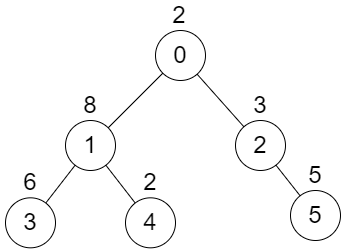
Input: n = 6, edges = [[0,1],[0,2],[1,3],[1,4],[2,5]], values = [2,8,3,6,2,5]
Output: 24
Explanation: Node 1's subtree has sum of values 16, while node 2's subtree has sum of values 8, so choosing these nodes will yield a score of 16 XOR 8 = 24. It can be proved that is the maximum possible score we can obtain.
Example 2:
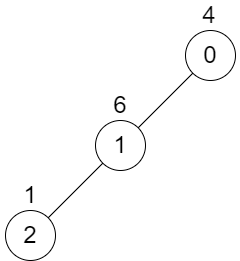
Input: n = 3, edges = [[0,1],[1,2]], values = [4,6,1]
Output: 0
Explanation: There is no possible way to select two non-overlapping subtrees, so we just return 0.
Constraints:
2 <= n <= 5 * 104edges.length == n - 10 <= ai, bi < nvalues.length == n1 <= values[i] <= 109- It is guaranteed that
edgesrepresents a valid tree.
Solutions
Solution 2: Explicit Stack + Binary Trie
Thinking
The score is the maximum XOR of two disjoint subtree sums, and $n$ reaches $5\times 10^4$. Recursing down a chain for the sums and again for the trie walk exhausts the call stack.
The bottleneck is those two chains: each call steps to the next child, so the depth tracks $n$.
A subtree sum depends only on its children. A query is valid only against a finished subtree that does not overlap the current one, which means the current sum must be inserted after its children.
Both walks use an explicit stack. The first accumulates $s[i]$ after the children. The second searches a $48$-bit binary trie on pop, then inserts $s[i]$ once the children are done. Sums reach about $10^{14}$, so each bit still prefers the opposite branch.
An explicit stack computes each subtree sum. A second stack queries a binary trie before inserting that sum, so the two subtrees do not overlap.
-
class Trie { Trie[] children = new Trie[2]; void insert(long x) { Trie node = this; for (int i = 47; i >= 0; --i) { int v = (int) (x >> i) & 1; if (node.children[v] == null) { node.children[v] = new Trie(); } node = node.children[v]; } } long search(long x) { Trie node = this; long res = 0; for (int i = 47; i >= 0; --i) { int v = (int) (x >> i) & 1; if (node == null) { return res; } if (node.children[v ^ 1] != null) { res = res << 1 | 1; node = node.children[v ^ 1]; } else { res <<= 1; node = node.children[v]; } } return res; } } class Solution { private List<Integer>[] g; private int[] vals; private long[] s; private Trie tree; private long ans; public long maxXor(int n, int[][] edges, int[] values) { g = new List[n]; s = new long[n]; vals = values; Arrays.setAll(g, k -> new ArrayList<>()); for (var e : edges) { int a = e[0], b = e[1]; g[a].add(b); g[b].add(a); } dfs1(0, -1); tree = new Trie(); dfs2(0, -1); return ans; } private void dfs2(int i, int fa) { ans = Math.max(ans, tree.search(s[i])); for (int j : g[i]) { if (j != fa) { dfs2(j, i); } } tree.insert(s[i]); } private long dfs1(int i, int fa) { long t = vals[i]; for (int j : g[i]) { if (j != fa) { t += dfs1(j, i); } } s[i] = t; return t; } } // Solution 2 class Trie { Trie[] children = new Trie[2]; void insert(long x) { Trie node = this; for (int i = 47; i >= 0; --i) { int v = (int) (x >> i) & 1; if (node.children[v] == null) { node.children[v] = new Trie(); } node = node.children[v]; } } long search(long x) { Trie node = this; long res = 0; for (int i = 47; i >= 0; --i) { int v = (int) (x >> i) & 1; if (node == null) { return res; } if (node.children[v ^ 1] != null) { res = res << 1 | 1; node = node.children[v ^ 1]; } else { res <<= 1; node = node.children[v]; } } return res; } } class Solution { public long maxXor(int n, int[][] edges, int[] values) { List<Integer>[] g = new List[n]; Arrays.setAll(g, k -> new ArrayList<>()); for (var e : edges) { int a = e[0], b = e[1]; g[a].add(b); g[b].add(a); } long[] s = new long[n]; Deque<int[]> stk = new ArrayDeque<>(); stk.push(new int[] {0, -1, 0}); while (!stk.isEmpty()) { int[] cur = stk.pop(); int i = cur[0], fa = cur[1], state = cur[2]; if (state == 0) { stk.push(new int[] {i, fa, 1}); for (int k = g[i].size() - 1; k >= 0; --k) { int j = g[i].get(k); if (j != fa) { stk.push(new int[] {j, i, 0}); } } } else { long t = values[i]; for (int j : g[i]) { if (j != fa) { t += s[j]; } } s[i] = t; } } long ans = 0; Trie tree = new Trie(); stk.push(new int[] {0, -1, 0}); while (!stk.isEmpty()) { int[] cur = stk.pop(); int i = cur[0], fa = cur[1], state = cur[2]; if (state == 0) { ans = Math.max(ans, tree.search(s[i])); stk.push(new int[] {i, fa, 1}); for (int k = g[i].size() - 1; k >= 0; --k) { int j = g[i].get(k); if (j != fa) { stk.push(new int[] {j, i, 0}); } } } else { tree.insert(s[i]); } } return ans; } } -
using ll = long long; class Trie { public: vector<Trie*> children; string v; Trie() : children(2) {} void insert(ll x) { Trie* node = this; for (int i = 47; ~i; --i) { int v = (x >> i) & 1; if (!node->children[v]) node->children[v] = new Trie(); node = node->children[v]; } } ll search(ll x) { Trie* node = this; ll res = 0; for (int i = 47; ~i; --i) { if (!node) return res; int v = (x >> i) & 1; if (node->children[v ^ 1]) { res = res << 1 | 1; node = node->children[v ^ 1]; } else { res <<= 1; node = node->children[v]; } } return res; } }; class Solution { public: long long maxXor(int n, vector<vector<int>>& edges, vector<int>& values) { vector<vector<int>> g(n); for (auto& e : edges) { int a = e[0], b = e[1]; g[a].emplace_back(b); g[b].emplace_back(a); } vector<ll> s(n); function<ll(int, int)> dfs1 = [&](int i, int fa) -> ll { ll t = values[i]; for (int j : g[i]) { if (j != fa) t += dfs1(j, i); } s[i] = t; return t; }; dfs1(0, -1); Trie tree; ll ans = 0; function<void(int, int)> dfs2 = [&](int i, int fa) { ans = max(ans, tree.search(s[i])); for (int j : g[i]) { if (j != fa) { dfs2(j, i); } } tree.insert(s[i]); }; dfs2(0, -1); return ans; } }; // Solution 2 using ll = long long; class Trie { public: vector<Trie*> children; string v; Trie() : children(2) {} void insert(ll x) { Trie* node = this; for (int i = 47; ~i; --i) { int v = (x >> i) & 1; if (!node->children[v]) node->children[v] = new Trie(); node = node->children[v]; } } ll search(ll x) { Trie* node = this; ll res = 0; for (int i = 47; ~i; --i) { if (!node) return res; int v = (x >> i) & 1; if (node->children[v ^ 1]) { res = res << 1 | 1; node = node->children[v ^ 1]; } else { res <<= 1; node = node->children[v]; } } return res; } }; class Solution { public: long long maxXor(int n, vector<vector<int>>& edges, vector<int>& values) { vector<vector<int>> g(n); for (auto& e : edges) { int a = e[0], b = e[1]; g[a].emplace_back(b); g[b].emplace_back(a); } vector<ll> s(n); vector<array<int, 3>> stk{{0, -1, 0}}; while (!stk.empty()) { auto [i, fa, state] = stk.back(); stk.pop_back(); if (state == 0) { stk.push_back({i, fa, 1}); for (int k = (int) g[i].size() - 1; k >= 0; --k) { int j = g[i][k]; if (j != fa) { stk.push_back({j, i, 0}); } } } else { ll t = values[i]; for (int j : g[i]) { if (j != fa) { t += s[j]; } } s[i] = t; } } Trie tree; ll ans = 0; stk.push_back({0, -1, 0}); while (!stk.empty()) { auto [i, fa, state] = stk.back(); stk.pop_back(); if (state == 0) { ans = max(ans, tree.search(s[i])); stk.push_back({i, fa, 1}); for (int k = (int) g[i].size() - 1; k >= 0; --k) { int j = g[i][k]; if (j != fa) { stk.push_back({j, i, 0}); } } } else { tree.insert(s[i]); } } return ans; } }; -
class Trie: def __init__(self): self.children = [None] * 2 def insert(self, x): node = self for i in range(47, -1, -1): v = (x >> i) & 1 if node.children[v] is None: node.children[v] = Trie() node = node.children[v] def search(self, x): node = self res = 0 for i in range(47, -1, -1): v = (x >> i) & 1 if node is None: return res if node.children[v ^ 1]: res = res << 1 | 1 node = node.children[v ^ 1] else: res <<= 1 node = node.children[v] return res class Solution: def maxXor(self, n: int, edges: List[List[int]], values: List[int]) -> int: def dfs1(i, fa): t = values[i] for j in g[i]: if j != fa: t += dfs1(j, i) s[i] = t return t def dfs2(i, fa): nonlocal ans ans = max(ans, tree.search(s[i])) for j in g[i]: if j != fa: dfs2(j, i) tree.insert(s[i]) g = defaultdict(list) for a, b in edges: g[a].append(b) g[b].append(a) s = [0] * n dfs1(0, -1) ans = 0 tree = Trie() dfs2(0, -1) return ans # Solution 2 class Trie: def __init__(self): self.children = [None] * 2 def insert(self, x): node = self for i in range(47, -1, -1): v = (x >> i) & 1 if node.children[v] is None: node.children[v] = Trie() node = node.children[v] def search(self, x): node = self res = 0 for i in range(47, -1, -1): v = (x >> i) & 1 if node is None: return res if node.children[v ^ 1]: res = res << 1 | 1 node = node.children[v ^ 1] else: res <<= 1 node = node.children[v] return res class Solution: def maxXor(self, n: int, edges: List[List[int]], values: List[int]) -> int: g = defaultdict(list) for a, b in edges: g[a].append(b) g[b].append(a) s = [0] * n stk = [(0, -1, 0)] while stk: i, fa, state = stk.pop() if state == 0: stk.append((i, fa, 1)) for j in reversed(g[i]): if j != fa: stk.append((j, i, 0)) else: t = values[i] for j in g[i]: if j != fa: t += s[j] s[i] = t ans = 0 tree = Trie() stk = [(0, -1, 0)] while stk: i, fa, state = stk.pop() if state == 0: ans = max(ans, tree.search(s[i])) stk.append((i, fa, 1)) for j in reversed(g[i]): if j != fa: stk.append((j, i, 0)) else: tree.insert(s[i]) return ans -
type Trie struct {
	children [2]*Trie
}

func newTrie() *Trie {
	return &Trie{}
}

func (this *Trie) insert(x int) {
	node := this
	for i := 47; i >= 0; i-- {
		v := (x >> i) & 1
		if node.children[v] == nil {
			node.children[v] = newTrie()
		}
		node = node.children[v]
	}
}

func (this *Trie) search(x int) int {
	node := this
	res := 0
	for i := 47; i >= 0; i-- {
		v := (x >> i) & 1
		if node == nil {
			return res
		}
		if node.children[v^1] != nil {
			res = res<<1 | 1
			node = node.children[v^1]
		} else {
			res <<= 1
			node = node.children[v]
		}
	}
	return res
}

func maxXor(n int, edges [][]int, values []int) int64 {
	g := make([][]int, n)
	for _, e := range edges {
		a, b := e[0], e[1]
		g[a] = append(g[a], b)
		g[b] = append(g[b], a)
	}
	s := make([]int, n)
	var dfs1 func(i, fa int) int
	dfs1 = func(i, fa int) int {
		t := values[i]
		for _, j := range g[i] {
			if j != fa {
				t += dfs1(j, i)
			}
		}
		s[i] = t
		return t
	}
	dfs1(0, -1)
	ans := 0
	tree := newTrie()
	var dfs2 func(i, fa int)
	dfs2 = func(i, fa int) {
		ans = max(ans, tree.search(s[i]))
		for _, j := range g[i] {
			if j != fa {
				dfs2(j, i)
			}
		}
		tree.insert(s[i])
	}
	dfs2(0, -1)
	return int64(ans)
}


// Solution 2
type Trie struct {
	children [2]*Trie
}

func newTrie() *Trie {
	return &Trie{}
}

func (this *Trie) insert(x int) {
	node := this
	for i := 47; i >= 0; i-- {
		v := (x >> i) & 1
		if node.children[v] == nil {
			node.children[v] = newTrie()
		}
		node = node.children[v]
	}
}

func (this *Trie) search(x int) int {
	node := this
	res := 0
	for i := 47; i >= 0; i-- {
		v := (x >> i) & 1
		if node == nil {
			return res
		}
		if node.children[v^1] != nil {
			res = res<<1 | 1
			node = node.children[v^1]
		} else {
			res <<= 1
			node = node.children[v]
		}
	}
	return res
}

func maxXor(n int, edges [][]int, values []int) int64 {
	g := make([][]int, n)
	for _, e := range edges {
		a, b := e[0], e[1]
		g[a] = append(g[a], b)
		g[b] = append(g[b], a)
	}
	s := make([]int, n)
	stk := [][3]int{{0, -1, 0}}
	for len(stk) > 0 {
		cur := stk[len(stk)-1]
		stk = stk[:len(stk)-1]
		i, fa, state := cur[0], cur[1], cur[2]
		if state == 0 {
			stk = append(stk, [3]int{i, fa, 1})
			for k := len(g[i]) - 1; k >= 0; k-- {
				j := g[i][k]
				if j != fa {
					stk = append(stk, [3]int{j, i, 0})
				}
			}
		} else {
			t := values[i]
			for _, j := range g[i] {
				if j != fa {
					t += s[j]
				}
			}
			s[i] = t
		}
	}
	ans := 0
	tree := newTrie()
	stk = [][3]int{{0, -1, 0}}
	for len(stk) > 0 {
		cur := stk[len(stk)-1]
		stk = stk[:len(stk)-1]
		i, fa, state := cur[0], cur[1], cur[2]
		if state == 0 {
			ans = max(ans, tree.search(s[i]))
			stk = append(stk, [3]int{i, fa, 1})
			for k := len(g[i]) - 1; k >= 0; k-- {
				j := g[i][k]
				if j != fa {
					stk = append(stk, [3]int{j, i, 0})
				}
			}
		} else {
			tree.insert(s[i])
		}
	}
	return int64(ans)
}