Welcome to Subscribe On Youtube
2368. Reachable Nodes With Restrictions
Description
There is an undirected tree with n nodes labeled from 0 to n - 1 and n - 1 edges.
You are given a 2D integer array edges of length n - 1 where edges[i] = [ai, bi] indicates that there is an edge between nodes ai and bi in the tree. You are also given an integer array restricted which represents restricted nodes.
Return the maximum number of nodes you can reach from node 0 without visiting a restricted node.
Note that node 0 will not be a restricted node.
Example 1:
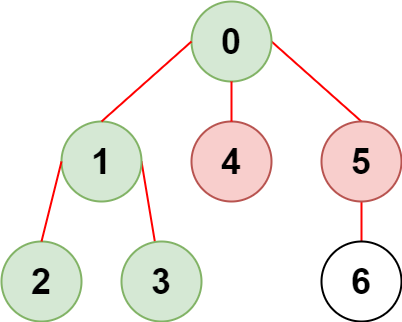
Input: n = 7, edges = [[0,1],[1,2],[3,1],[4,0],[0,5],[5,6]], restricted = [4,5]
Output: 4
Explanation: The diagram above shows the tree.
We have that [0,1,2,3] are the only nodes that can be reached from node 0 without visiting a restricted node.
Example 2:
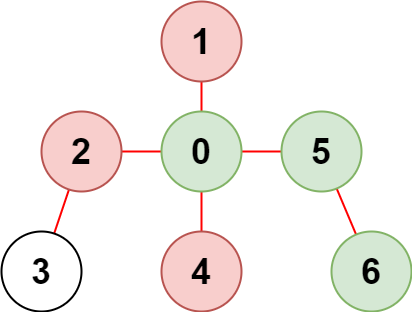
Input: n = 7, edges = [[0,1],[0,2],[0,5],[0,4],[3,2],[6,5]], restricted = [4,2,1]
Output: 3
Explanation: The diagram above shows the tree.
We have that [0,5,6] are the only nodes that can be reached from node 0 without visiting a restricted node.
Constraints:
2 <= n <= 105edges.length == n - 1edges[i].length == 20 <= ai, bi < nai != biedgesrepresents a valid tree.1 <= restricted.length < n1 <= restricted[i] < n- All the values of
restrictedare unique.
Solutions
Solution 1: DFS
First, we construct an adjacency list $g$ based on the given edges, where $g[i]$ represents the list of nodes adjacent to node $i$. Then we define a hash table $vis$ to record the restricted nodes or nodes that have been visited, and initially add the restricted nodes to $vis$.
Next, we define a depth-first search function $dfs(i)$, which represents the number of nodes that can be reached starting from node $i$. In the $dfs(i)$ function, we first add node $i$ to $vis$, then traverse the nodes $j$ adjacent to node $i$. If $j$ is not in $vis$, we recursively call $dfs(j)$ and add the return value to the result.
Finally, we return $dfs(0)$.
The time complexity is $O(n)$, and the space complexity is $O(n)$. Where $n$ is the number of nodes.
Solution 2: BFS
Similar to Solution 1, we first construct an adjacency list $g$ based on the given edges, then define a hash table $vis$ to record the restricted nodes or nodes that have been visited, and initially add the restricted nodes to $vis$.
Next, we use breadth-first search to traverse the entire graph and count the number of reachable nodes. We define a queue $q$, initially add node $0$ to $q$, and add node $0$ to $vis$. Then we continuously take out node $i$ from $q$, accumulate the answer, and add the unvisited adjacent nodes of node $i$ to $q$ and $vis$.
After the traversal, we return the answer.
The time complexity is $O(n)$, and the space complexity is $O(n)$. Where $n$ is the number of nodes.
Solution 3: Explicit Stack
Thinking
From node $0$ on a tree we cannot enter restricted nodes. With $n \le 10^5$, one traversal is enough. Treat restricted nodes as already visited so the walk never crosses them. Recursing to the next node is too deep: a chain makes the call depth $n$.
After the adjacency list is built, an explicit stack runs a depth-first walk. When a node is popped and still unvisited, it counts toward the answer and its unvisited neighbors are pushed.
First, we construct an adjacency list $g$ based on the given edges, where $g[i]$ represents the list of nodes adjacent to node $i$. Then we define a hash table $vis$ to record the restricted nodes or nodes that have been visited, and initially add the restricted nodes to $vis$.
Next, an explicit stack walks from node $0$. When node $i$ is popped and still unvisited, we add it to $vis$, count it, and push its unvisited neighbors.
Finally, we return the number of nodes counted.
The time complexity is $O(n)$, and the space complexity is $O(n)$. Where $n$ is the number of nodes.
-
class Solution { private List<Integer>[] g; private boolean[] vis; private int ans; public int reachableNodes(int n, int[][] edges, int[] restricted) { g = new List[n]; Arrays.setAll(g, k -> new ArrayList<>()); vis = new boolean[n]; for (int v : restricted) { vis[v] = true; } for (int[] e : edges) { int a = e[0], b = e[1]; g[a].add(b); g[b].add(a); } ans = 0; dfs(0); return ans; } private void dfs(int u) { if (vis[u]) { return; } ++ans; vis[u] = true; for (int v : g[u]) { dfs(v); } } } // Solution 2 class Solution { public int reachableNodes(int n, int[][] edges, int[] restricted) { List<Integer>[] g = new List[n]; boolean[] vis = new boolean[n]; Arrays.setAll(g, k -> new ArrayList<>()); for (var e : edges) { int a = e[0], b = e[1]; g[a].add(b); g[b].add(a); } for (int v : restricted) { vis[v] = true; } Deque<Integer> q = new ArrayDeque<>(); q.offer(0); int ans = 0; for (vis[0] = true; !q.isEmpty(); ++ans) { int i = q.pollFirst(); for (int j : g[i]) { if (!vis[j]) { q.offer(j); vis[j] = true; } } } return ans; } } // Solution 3 class Solution { public int reachableNodes(int n, int[][] edges, int[] restricted) { List<Integer>[] g = new List[n]; Arrays.setAll(g, k -> new ArrayList<>()); for (var e : edges) { int a = e[0], b = e[1]; g[a].add(b); g[b].add(a); } boolean[] vis = new boolean[n]; for (int i : restricted) { vis[i] = true; } int ans = 0; Deque<Integer> stk = new ArrayDeque<>(); stk.push(0); while (!stk.isEmpty()) { int i = stk.pop(); if (vis[i]) { continue; } vis[i] = true; ++ans; for (int j : g[i]) { if (!vis[j]) { stk.push(j); } } } return ans; } } -
class Solution { public: int ans; int reachableNodes(int n, vector<vector<int>>& edges, vector<int>& restricted) { vector<vector<int>> g(n); for (auto& e : edges) { int a = e[0], b = e[1]; g[a].push_back(b); g[b].push_back(a); } vector<bool> vis(n); for (int v : restricted) vis[v] = true; ans = 0; dfs(0, g, vis); return ans; } void dfs(int u, vector<vector<int>>& g, vector<bool>& vis) { if (vis[u]) return; vis[u] = true; ++ans; for (int v : g[u]) dfs(v, g, vis); } }; // Solution 2 class Solution { public: int reachableNodes(int n, vector<vector<int>>& edges, vector<int>& restricted) { vector<int> g[n]; vector<int> vis(n); for (auto& e : edges) { int a = e[0], b = e[1]; g[a].emplace_back(b); g[b].emplace_back(a); } for (int i : restricted) { vis[i] = true; } queue<int> q{{0}}; int ans = 0; for (vis[0] = true; !q.empty(); ++ans) { int i = q.front(); q.pop(); for (int j : g[i]) { if (!vis[j]) { vis[j] = true; q.push(j); } } } return ans; } }; // Solution 3 class Solution { public: int reachableNodes(int n, vector<vector<int>>& edges, vector<int>& restricted) { vector<vector<int>> g(n); vector<int> vis(n); for (auto& e : edges) { int a = e[0], b = e[1]; g[a].emplace_back(b); g[b].emplace_back(a); } for (int i : restricted) { vis[i] = true; } int ans = 0; vector<int> stk{0}; while (!stk.empty()) { int i = stk.back(); stk.pop_back(); if (vis[i]) { continue; } vis[i] = true; ++ans; for (int j : g[i]) { if (!vis[j]) { stk.emplace_back(j); } } } return ans; } }; -
class Solution: def reachableNodes( self, n: int, edges: List[List[int]], restricted: List[int] ) -> int: g = defaultdict(list) vis = [False] * n for v in restricted: vis[v] = True for a, b in edges: g[a].append(b) g[b].append(a) def dfs(u): nonlocal ans if vis[u]: return ans += 1 vis[u] = True for v in g[u]: dfs(v) ans = 0 dfs(0) return ans # Solution 2 class Solution: def reachableNodes( self, n: int, edges: List[List[int]], restricted: List[int] ) -> int: g = defaultdict(list) for a, b in edges: g[a].append(b) g[b].append(a) vis = set(restricted + [0]) q = deque([0]) ans = 0 while q: i = q.popleft() ans += 1 for j in g[i]: if j not in vis: q.append(j) vis.add(j) return ans # Solution 3 class Solution: def reachableNodes( self, n: int, edges: List[List[int]], restricted: List[int] ) -> int: g = [[] for _ in range(n)] for a, b in edges: g[a].append(b) g[b].append(a) vis = [False] * n for i in restricted: vis[i] = True ans = 0 stk = [0] while stk: i = stk.pop() if vis[i]: continue vis[i] = True ans += 1 for j in g[i]: if not vis[j]: stk.append(j) return ans -
func reachableNodes(n int, edges [][]int, restricted []int) int { g := make([][]int, n) for _, e := range edges { a, b := e[0], e[1] g[a] = append(g[a], b) g[b] = append(g[b], a) } vis := make([]bool, n) for _, v := range restricted { vis[v] = true } ans := 0 var dfs func(u int) dfs = func(u int) { if vis[u] { return } vis[u] = true ans++ for _, v := range g[u] { dfs(v) } } dfs(0) return ans } // Solution 2 func reachableNodes(n int, edges [][]int, restricted []int) (ans int) { g := make([][]int, n) vis := make([]bool, n) for _, e := range edges { a, b := e[0], e[1] g[a] = append(g[a], b) g[b] = append(g[b], a) } for _, i := range restricted { vis[i] = true } q := []int{0} for vis[0] = true; len(q) > 0; ans++ { i := q[0] q = q[1:] for _, j := range g[i] { if !vis[j] { vis[j] = true q = append(q, j) } } } return } // Solution 3 func reachableNodes(n int, edges [][]int, restricted []int) int { g := make([][]int, n) vis := make([]bool, n) for _, e := range edges { a, b := e[0], e[1] g[a] = append(g[a], b) g[b] = append(g[b], a) } for _, i := range restricted { vis[i] = true } ans := 0 stk := []int{0} for len(stk) > 0 { i := stk[len(stk)-1] stk = stk[:len(stk)-1] if vis[i] { continue } vis[i] = true ans++ for _, j := range g[i] { if !vis[j] { stk = append(stk, j) } } } return ans } -
function reachableNodes(n: number, edges: number[][], restricted: number[]): number {
    let res = 0;
    const vis = new Array(n).fill(false);
    const map = new Map<number, number[]>();
    for (const [start, end] of edges) {
        map.set(start, [...(map.get(start) ?? []), end]);
        map.set(end, [...(map.get(end) ?? []), start]);
    }
    const dfs = (cur: number) => {
        if (restricted.includes(cur) || vis[cur]) {
            return;
        }
        res++;
        vis[cur] = true;
        for (const item of map.get(cur) ?? []) {
            dfs(item);
        }
    };
    dfs(0);

    return res;
}


// Solution 2
function reachableNodes(n: number, edges: number[][], restricted: number[]): number {
    const vis: boolean[] = Array(n).fill(false);
    const g: number[][] = Array.from({ length: n }, () => []);
    for (const [a, b] of edges) {
        g[a].push(b);
        g[b].push(a);
    }
    for (const i of restricted) {
        vis[i] = true;
    }
    const q: number[] = [0];
    let ans = 0;
    for (vis[0] = true; q.length; ++ans) {
        const i = q.pop()!;
        for (const j of g[i]) {
            if (!vis[j]) {
                vis[j] = true;
                q.push(j);
            }
        }
    }
    return ans;
}


// Solution 3
function reachableNodes(n: number, edges: number[][], restricted: number[]): number {
    const vis: boolean[] = Array(n).fill(false);
    const g: number[][] = Array.from({ length: n }, () => []);
    for (const [a, b] of edges) {
        g[a].push(b);
        g[b].push(a);
    }
    for (const i of restricted) {
        vis[i] = true;
    }
    let ans = 0;
    const stk: number[] = [0];
    while (stk.length) {
        const i = stk.pop()!;
        if (vis[i]) {
            continue;
        }
        vis[i] = true;
        ++ans;
        for (const j of g[i]) {
            if (!vis[j]) {
                stk.push(j);
            }
        }
    }
    return ans;
}