Welcome to Subscribe On Youtube
2061. Number of Spaces Cleaning Robot Cleaned
Description
A room is represented by a 0-indexed 2D binary matrix room where a 0 represents an empty space and a 1 represents a space with an object. The top left corner of the room will be empty in all test cases.
A cleaning robot starts at the top left corner of the room and is facing right. The robot will continue heading straight until it reaches the edge of the room or it hits an object, after which it will turn 90 degrees clockwise and repeat this process. The starting space and all spaces that the robot visits are cleaned by it.
Return the number of clean spaces in the room if the robot runs indefinetely.
Example 1:
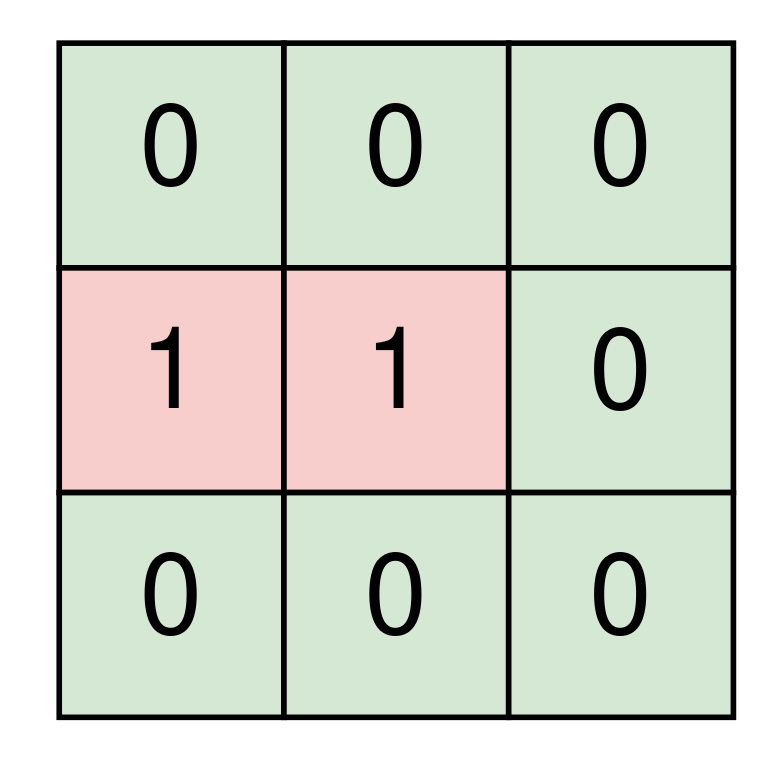
Input: room = [[0,0,0],[1,1,0],[0,0,0]]
Output: 7
Explanation:
The robot cleans the spaces at (0, 0), (0, 1), and (0, 2).
The robot is at the edge of the room, so it turns 90 degrees clockwise and now faces down.
The robot cleans the spaces at (1, 2), and (2, 2).
The robot is at the edge of the room, so it turns 90 degrees clockwise and now faces left.
The robot cleans the spaces at (2, 1), and (2, 0).
The robot has cleaned all 7 empty spaces, so return 7.
Example 2:
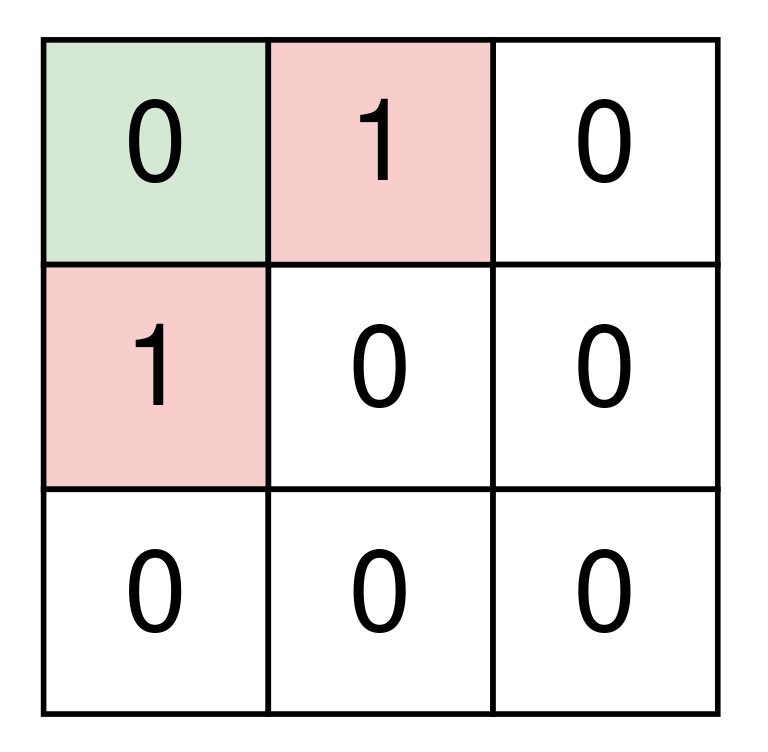
Input: room = [[0,1,0],[1,0,0],[0,0,0]]
Output: 1
Explanation:
The robot cleans the space at (0, 0).
The robot hits an object, so it turns 90 degrees clockwise and now faces down.
The robot hits an object, so it turns 90 degrees clockwise and now faces left.
The robot is at the edge of the room, so it turns 90 degrees clockwise and now faces up.
The robot is at the edge of the room, so it turns 90 degrees clockwise and now faces right.
The robot is back at its starting position.
The robot has cleaned 1 space, so return 1.
Constraints:
m == room.lengthn == room[r].length1 <= m, n <= 300room[r][c]is either0or1.room[0][0] == 0
Solutions
Solution 1: Depth-First Search + Set
We start from the starting point $(0, 0)$ to simulate the cleaning process of the robot. Each time it cleans the current position, it then takes a step forward. If it encounters a wall or a position that has been cleaned, it rotates 90 degrees clockwise and continues cleaning.
In the process, we use a triplet $(i, j, k)$ to represent the robot’s current position $(i, j)$ and direction $k$, where the value range of $k$ is $0, 1, 2, 3$, which means right, down, left, and up respectively. We use a set vis to record all visited state triples.
Time complexity $O(m \times n)$, space complexity $O(m \times n)$. Among them, $m$ and $n$ are the number of rows and columns of the room respectively.
Solution 2
This implementation uses set. It traverses the relevant values and updates its state as each value is processed. A keyed container records values that must be found or updated efficiently. After all required states have been considered, the maintained result is returned.
-
class Solution { private boolean[][][] vis; private int[][] room; private int ans; public int numberOfCleanRooms(int[][] room) { vis = new boolean[room.length][room[0].length][4]; this.room = room; dfs(0, 0, 0); return ans; } private void dfs(int i, int j, int k) { if (vis[i][j][k]) { return; } int[] dirs = {0, 1, 0, -1, 0}; ans += room[i][j] == 0 ? 1 : 0; room[i][j] = -1; vis[i][j][k] = true; int x = i + dirs[k], y = j + dirs[k + 1]; if (x >= 0 && x < room.length && y >= 0 && y < room[0].length && room[x][y] != 1) { dfs(x, y, k); } else { dfs(i, j, (k + 1) % 4); } } } // Solution 2 class Solution { public int numberOfCleanRooms(int[][] room) { int[] dirs = {0, 1, 0, -1, 0}; int i = 0, j = 0, k = 0; int m = room.length, n = room[0].length; boolean[][][] vis = new boolean[m][n][4]; int ans = 0; while (!vis[i][j][k]) { vis[i][j][k] = true; ans += room[i][j] == 0 ? 1 : 0; room[i][j] = -1; int x = i + dirs[k], y = j + dirs[k + 1]; if (x >= 0 && x < m && y >= 0 && y < n && room[x][y] != 1) { i = x; j = y; } else { k = (k + 1) % 4; } } return ans; } } -
class Solution { public: int numberOfCleanRooms(vector<vector<int>>& room) { int m = room.size(), n = room[0].size(); bool vis[m][n][4]; memset(vis, false, sizeof(vis)); int dirs[5] = {0, 1, 0, -1, 0}; int ans = 0; function<void(int, int, int)> dfs = [&](int i, int j, int k) { if (vis[i][j][k]) { return; } ans += room[i][j] == 0; room[i][j] = -1; vis[i][j][k] = true; int x = i + dirs[k], y = j + dirs[k + 1]; if (x >= 0 && x < m && y >= 0 && y < n && room[x][y] != 1) { dfs(x, y, k); } else { dfs(i, j, (k + 1) % 4); } }; dfs(0, 0, 0); return ans; } }; // Solution 2 class Solution { public: int numberOfCleanRooms(vector<vector<int>>& room) { int dirs[5] = {0, 1, 0, -1, 0}; int i = 0, j = 0, k = 0; int m = room.size(), n = room[0].size(); bool vis[m][n][4]; memset(vis, false, sizeof(vis)); int ans = 0; while (!vis[i][j][k]) { vis[i][j][k] = true; ans += room[i][j] == 0 ? 1 : 0; room[i][j] = -1; int x = i + dirs[k], y = j + dirs[k + 1]; if (x >= 0 && x < m && y >= 0 && y < n && room[x][y] != 1) { i = x; j = y; } else { k = (k + 1) % 4; } } return ans; } }; -
class Solution: def numberOfCleanRooms(self, room: List[List[int]]) -> int: def dfs(i, j, k): if (i, j, k) in vis: return nonlocal ans ans += room[i][j] == 0 room[i][j] = -1 vis.add((i, j, k)) x, y = i + dirs[k], j + dirs[k + 1] if 0 <= x < len(room) and 0 <= y < len(room[0]) and room[x][y] != 1: dfs(x, y, k) else: dfs(i, j, (k + 1) % 4) vis = set() dirs = (0, 1, 0, -1, 0) ans = 0 dfs(0, 0, 0) return ans # Solution 2 class Solution: def numberOfCleanRooms(self, room: List[List[int]]) -> int: dirs = (0, 1, 0, -1, 0) i = j = k = 0 ans = 0 vis = set() while (i, j, k) not in vis: vis.add((i, j, k)) ans += room[i][j] == 0 room[i][j] = -1 x, y = i + dirs[k], j + dirs[k + 1] if 0 <= x < len(room) and 0 <= y < len(room[0]) and room[x][y] != 1: i, j = x, y else: k = (k + 1) % 4 return ans -
func numberOfCleanRooms(room [][]int) (ans int) {
	m, n := len(room), len(room[0])
	vis := make([][][4]bool, m)
	for i := range vis {
		vis[i] = make([][4]bool, n)
	}
	dirs := [5]int{0, 1, 0, -1, 0}
	var dfs func(i, j, k int)
	dfs = func(i, j, k int) {
		if vis[i][j][k] {
			return
		}
		if room[i][j] == 0 {
			ans++
			room[i][j] = -1
		}
		vis[i][j][k] = true
		x, y := i+dirs[k], j+dirs[k+1]
		if x >= 0 && x < m && y >= 0 && y < n && room[x][y] != 1 {
			dfs(x, y, k)
		} else {
			dfs(i, j, (k+1)%4)
		}
	}
	dfs(0, 0, 0)
	return
}


// Solution 2
func numberOfCleanRooms(room [][]int) (ans int) {
	m, n := len(room), len(room[0])
	vis := make([][][4]bool, m)
	for i := range vis {
		vis[i] = make([][4]bool, n)
	}
	dirs := [5]int{0, 1, 0, -1, 0}
	var i, j, k int
	for !vis[i][j][k] {
		vis[i][j][k] = true
		if room[i][j] == 0 {
			ans++
			room[i][j] = -1
		}
		x, y := i+dirs[k], j+dirs[k+1]
		if x >= 0 && x < m && y >= 0 && y < n && room[x][y] != 1 {
			i, j = x, y
		} else {
			k = (k + 1) % 4
		}
	}
	return
}