Welcome to Subscribe On Youtube
1954. Minimum Garden Perimeter to Collect Enough Apples
Description
In a garden represented as an infinite 2D grid, there is an apple tree planted at every integer coordinate. The apple tree planted at an integer coordinate (i, j) has |i| + |j| apples growing on it.
You will buy an axis-aligned square plot of land that is centered at (0, 0).
Given an integer neededApples, return the minimum perimeter of a plot such that at least neededApples apples are inside or on the perimeter of that plot.
The value of |x| is defined as:
xifx >= 0-xifx < 0
Example 1:
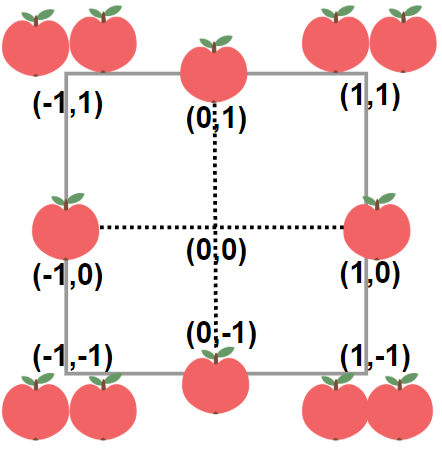
Input: neededApples = 1
Output: 8
Explanation: A square plot of side length 1 does not contain any apples.
However, a square plot of side length 2 has 12 apples inside (as depicted in the image above).
The perimeter is 2 * 4 = 8.
Example 2:
Input: neededApples = 13
Output: 16
Example 3:
Input: neededApples = 1000000000
Output: 5040
Constraints:
1 <= neededApples <= 1015
Solutions
Solution 1: Direct Implementation
Assume that the coordinates of the upper right corner of the square are $(n, n)$, then its side length is $2n$, its perimeter is $8n$, and the total number of apples inside is:
\[\begin{aligned} &\sum_{x=-n}^{n} \sum_{y=-n}^{n} |x| + |y| \\ \end{aligned}\]Since $x$ and $y$ are symmetric, they can be simplified to:
\[\begin{aligned} &\sum_{x=-n}^{n} \sum_{y=-n}^{n} |x| + |y| \\ &= 2 \sum_{x=-n}^{n} \sum_{y=-n}^{n} |x| \\ &= 2 \sum_{x=-n}^{n} (2n + 1) |x| \\ &= 2 (2n + 1) \sum_{x=-n}^{n} |x| \\ &= 2n(n+1)(2n+1) \end{aligned}\]So, we just need to enumerate $n$ until we find the first $n$ that satisfies $2n(n+1)(2n+1) \geq neededApples$.
Time complexity $O(m^{\frac{1}{3}})$, where $m$ is the value of $neededApples$. Space complexity $O(1)$.
Solution 2
We can also enumerate $n$ in two, with time complexity $O(\log m)$.
-
class Solution { public long minimumPerimeter(long neededApples) { long x = 1; while (2 * x * (x + 1) * (2 * x + 1) < neededApples) { ++x; } return 8 * x; } } // Solution 2 class Solution { public long minimumPerimeter(long neededApples) { long l = 1, r = 100000; while (l < r) { long mid = (l + r) >> 1; if (2 * mid * (mid + 1) * (2 * mid + 1) >= neededApples) { r = mid; } else { l = mid + 1; } } return l * 8; } } -
class Solution { public: long long minimumPerimeter(long long neededApples) { long long x = 1; while (2 * x * (x + 1) * (2 * x + 1) < neededApples) { ++x; } return 8 * x; } }; // Solution 2 class Solution { public: long long minimumPerimeter(long long neededApples) { long long l = 1, r = 100000; while (l < r) { long mid = (l + r) >> 1; if (2 * mid * (mid + 1) * (2 * mid + 1) >= neededApples) { r = mid; } else { l = mid + 1; } } return l * 8; } }; -
class Solution: def minimumPerimeter(self, neededApples: int) -> int: x = 1 while 2 * x * (x + 1) * (2 * x + 1) < neededApples: x += 1 return x * 8 # Solution 2 class Solution: def minimumPerimeter(self, neededApples: int) -> int: l, r = 1, 100000 while l < r: mid = (l + r) >> 1 if 2 * mid * (mid + 1) * (2 * mid + 1) >= neededApples: r = mid else: l = mid + 1 return l * 8 -
func minimumPerimeter(neededApples int64) int64 { var x int64 = 1 for 2*x*(x+1)*(2*x+1) < neededApples { x++ } return 8 * x } // Solution 2 func minimumPerimeter(neededApples int64) int64 { var l, r int64 = 1, 100000 for l < r { mid := (l + r) >> 1 if 2*mid*(mid+1)*(2*mid+1) >= neededApples { r = mid } else { l = mid + 1 } } return l * 8 } -
function minimumPerimeter(neededApples: number): number {
    let x = 1;
    while (2 * x * (x + 1) * (2 * x + 1) < neededApples) {
        ++x;
    }
    return 8 * x;
}


// Solution 2
function minimumPerimeter(neededApples: number): number {
    let l = 1;
    let r = 100000;
    while (l < r) {
        const mid = (l + r) >> 1;
        if (2 * mid * (mid + 1) * (2 * mid + 1) >= neededApples) {
            r = mid;
        } else {
            l = mid + 1;
        }
    }
    return 8 * l;
}