Welcome to Subscribe On Youtube
1823. Find the Winner of the Circular Game
Description
There are n friends that are playing a game. The friends are sitting in a circle and are numbered from 1 to n in clockwise order. More formally, moving clockwise from the ith friend brings you to the (i+1)th friend for 1 <= i < n, and moving clockwise from the nth friend brings you to the 1st friend.
The rules of the game are as follows:
- Start at the
1stfriend. - Count the next
kfriends in the clockwise direction including the friend you started at. The counting wraps around the circle and may count some friends more than once. - The last friend you counted leaves the circle and loses the game.
- If there is still more than one friend in the circle, go back to step
2starting from the friend immediately clockwise of the friend who just lost and repeat. - Else, the last friend in the circle wins the game.
Given the number of friends, n, and an integer k, return the winner of the game.
Example 1:
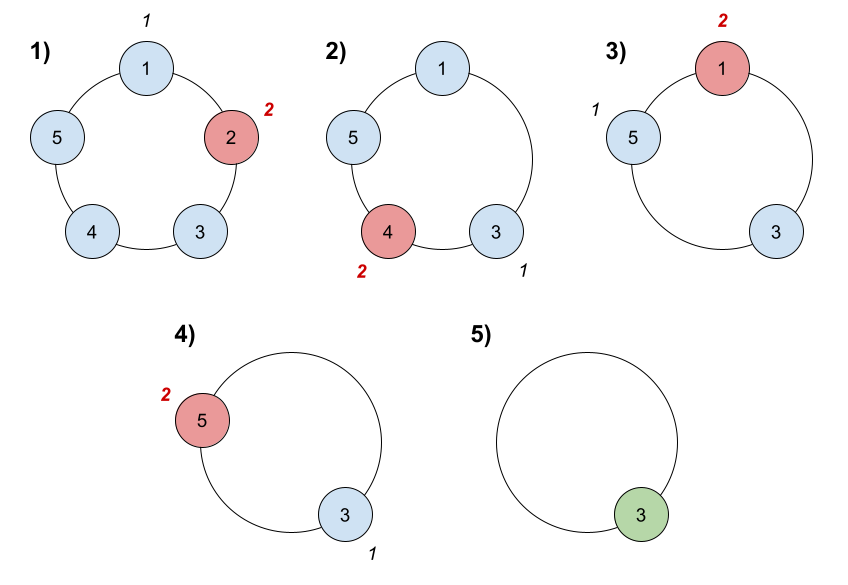
Input: n = 5, k = 2
Output: 3
Explanation: Here are the steps of the game:
1) Start at friend 1.
2) Count 2 friends clockwise, which are friends 1 and 2.
3) Friend 2 leaves the circle. Next start is friend 3.
4) Count 2 friends clockwise, which are friends 3 and 4.
5) Friend 4 leaves the circle. Next start is friend 5.
6) Count 2 friends clockwise, which are friends 5 and 1.
7) Friend 1 leaves the circle. Next start is friend 3.
8) Count 2 friends clockwise, which are friends 3 and 5.
9) Friend 5 leaves the circle. Only friend 3 is left, so they are the winner.
Example 2:
Input: n = 6, k = 5
Output: 1
Explanation: The friends leave in this order: 5, 4, 6, 2, 3. The winner is friend 1.
Constraints:
1 <= k <= n <= 500
Follow up:
Could you solve this problem in linear time with constant space?
Solutions
Solution 1: Direct Implementation
This implementation follows the required operations directly. After all required states have been considered, the maintained result is returned.
Solution 2: Simulation
This implementation follows the required operations directly. It traverses the relevant values and updates its state as each value is processed. After all required states have been considered, the maintained result is returned.
-
class Solution { public int findTheWinner(int n, int k) { if (n == 1) { return 1; } int ans = (findTheWinner(n - 1, k) + k) % n; return ans == 0 ? n : ans; } } -
class Solution { public: int findTheWinner(int n, int k) { if (n == 1) return 1; int ans = (findTheWinner(n - 1, k) + k) % n; return ans == 0 ? n : ans; } }; -
class Solution: def findTheWinner(self, n: int, k: int) -> int: if n == 1: return 1 ans = (k + self.findTheWinner(n - 1, k)) % n return n if ans == 0 else ans -
func findTheWinner(n int, k int) int { if n == 1 { return 1 } ans := (findTheWinner(n-1, k) + k) % n if ans == 0 { return n } return ans } -
class LinkNode { public val: number; public next: LinkNode; constructor(val: number = 0, next?: LinkNode) { this.val = val; this.next = next; } } function findTheWinner(n: number, k: number): number { if (k === 1) { return n; } const dummy = new LinkNode(0); let cur = dummy; for (let i = 1; i <= n; i++) { cur.next = new LinkNode(i); cur = cur.next; } cur.next = dummy.next; cur = dummy; let count = 0; while (cur.next != cur) { count++; if (count === k) { cur.next = cur.next.next; count = 0; } else { cur = cur.next; } } return cur.val; } // Solution 2 function findTheWinner(n: number, k: number): number { const arr = Array.from({ length: n }, (_, i) => i + 1); let i = 0; while (arr.length > 1) { i = (i + k - 1) % arr.length; arr.splice(i, 1); } return arr[0]; } -
/** * @param {number} n * @param {number} k * @return {number} */ var findTheWinner = function (n, k) { if (n === 1) { return 1; } const ans = (k + findTheWinner(n - 1, k)) % n; return ans ? ans : n; }; // Solution 2 function findTheWinner(n, k) { const arr = Array.from({ length: n }, (_, i) => i + 1); let i = 0; while (arr.length > 1) { i = (i + k - 1) % arr.length; arr.splice(i, 1); } return arr[0]; } -
impl Solution {
    pub fn find_the_winner(n: i32, k: i32) -> i32 {
        if n == 1 {
            return 1;
        }
		let mut ans = (k + Solution::find_the_winner(n - 1, k)) % n;
		return if ans == 0 { n } else { ans };
    }
}