Welcome to Subscribe On Youtube
633. Sum of Square Numbers
Description
Given a non-negative integer c, decide whether there're two integers a and b such that a2 + b2 = c.
Example 1:
Input: c = 5
Output: true
Explanation: 1 * 1 + 2 * 2 = 5
Example 2:
Input: c = 3
Output: false
Constraints:
0 <= c <= 231 - 1
Solutions
Solution 1
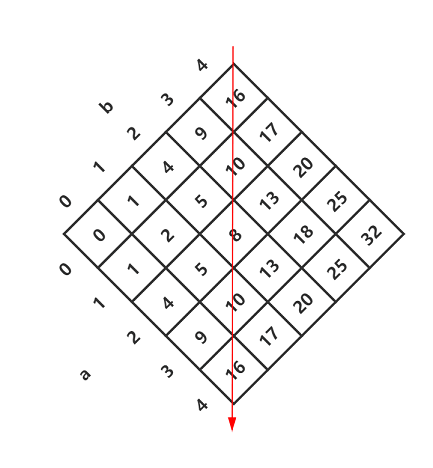
The picture above shows the relationship between a, b, and c. This question is actually looking up c in this table
From the upper right corner of the table, it is not difficult to find that it is similar to a binary search tree, so just start from the upper right corner and search according to the law of the binary search tree
Solution 2: Mathematics
This problem is essentially about the conditions under which a number can be expressed as the sum of two squares. This theorem dates back to Fermat and Euler and is a classic result in number theory.
Specifically, the theorem can be stated as follows:
A positive integer $n$ can be expressed as the sum of two squares if and only if all prime factors of $n$ of the form $4k + 3$ have even powers.
This means that if we decompose $n$ into the product of its prime factors, $n = p_1^{e_1} p_2^{e_2} \cdots p_k^{e_k}$, where $p_i$ are primes and $e_i$ are their corresponding exponents, then $n$ can be expressed as the sum of two squares if and only if all prime factors $p_i$ of the form $4k + 3$ have even exponents $e_i$.
More formally, if $p_i$ is a prime of the form $4k + 3$, then for each such $p_i$, $e_i$ must be even.
For example:
- The number $13$ is a prime and $13 \equiv 1 \pmod{4}$, so it can be expressed as the sum of two squares, i.e., $13 = 2^2 + 3^2$.
- The number $21$ can be decomposed into $3 \times 7$, where both $3$ and $7$ are prime factors of the form $4k + 3$ and their exponents are $1$ (odd), so $21$ cannot be expressed as the sum of two squares.
In summary, this theorem is very important in number theory for determining whether a number can be expressed as the sum of two squares.
The time complexity is $O(\sqrt{c})$, where $c$ is the given non-negative integer. The space complexity is $O(1)$.
-
class Solution { public boolean judgeSquareSum(int c) { long a = 0, b = (long) Math.sqrt(c); while (a <= b) { long s = a * a + b * b; if (s == c) { return true; } if (s < c) { ++a; } else { --b; } } return false; } } // Solution 2 class Solution { public boolean judgeSquareSum(int c) { int n = (int) Math.sqrt(c); for (int i = 2; i <= n; ++i) { if (c % i == 0) { int exp = 0; while (c % i == 0) { c /= i; ++exp; } if (i % 4 == 3 && exp % 2 != 0) { return false; } } } return c % 4 != 3; } } -
class Solution { public: bool judgeSquareSum(int c) { long a = 0, b = (long) sqrt(c); while (a <= b) { long s = a * a + b * b; if (s == c) return true; if (s < c) ++a; else --b; } return false; } }; // Solution 2 class Solution { public: bool judgeSquareSum(int c) { int n = sqrt(c); for (int i = 2; i <= n; ++i) { if (c % i == 0) { int exp = 0; while (c % i == 0) { c /= i; ++exp; } if (i % 4 == 3 && exp % 2 != 0) { return false; } } } return c % 4 != 3; } }; -
class Solution: def judgeSquareSum(self, c: int) -> bool: a, b = 0, int(sqrt(c)) while a <= b: s = a**2 + b**2 if s == c: return True if s < c: a += 1 else: b -= 1 return False # Solution 2 class Solution: def judgeSquareSum(self, c: int) -> bool: for i in range(2, int(sqrt(c)) + 1): if c % i == 0: exp = 0 while c % i == 0: c //= i exp += 1 if i % 4 == 3 and exp % 2 != 0: return False return c % 4 != 3 -
func judgeSquareSum(c int) bool { a, b := 0, int(math.Sqrt(float64(c))) for a <= b { s := a*a + b*b if s == c { return true } if s < c { a++ } else { b-- } } return false } // Solution 2 func judgeSquareSum(c int) bool { n := int(math.Sqrt(float64(c))) for i := 2; i <= n; i++ { if c%i == 0 { exp := 0 for c%i == 0 { c /= i exp++ } if i%4 == 3 && exp%2 != 0 { return false } } } return c%4 != 3 } -
function judgeSquareSum(c: number): boolean { let a = 0, b = Math.floor(Math.sqrt(c)); while (a <= b) { let sum = a ** 2 + b ** 2; if (sum == c) return true; if (sum < c) { ++a; } else { --b; } } return false; } // Solution 2 function judgeSquareSum(c: number): boolean { const n = Math.floor(Math.sqrt(c)); for (let i = 2; i <= n; ++i) { if (c % i === 0) { let exp = 0; while (c % i === 0) { c /= i; ++exp; } if (i % 4 === 3 && exp % 2 !== 0) { return false; } } } return c % 4 !== 3; } -
use std::cmp::Ordering;
impl Solution {
    pub fn judge_square_sum(c: i32) -> bool {
        let c = c as i64;
        let mut left = 0;
        let mut right = (c as f64).sqrt() as i64;
        while left <= right {
            let num = left * left + right * right;
            match num.cmp(&c) {
                Ordering::Less => {
                    left += 1;
                }
                Ordering::Greater => {
                    right -= 1;
                }
                Ordering::Equal => {
                    return true;
                }
            }
        }
        false
    }
}